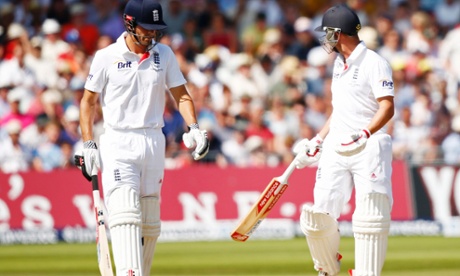
Alastair Cook - 7 Given the circus of hype surrounding the series and in particular the pressure of continuing Andrew Strauss' recent success in Ashes cricket, captain Cook could have been forgiven a nervous performance at Trent Bridge. Yet despite only scoring 13 in the first innings, he came back to score a vital half-century in the second and rescue his side from another early collapse.
As captain he continued his legacy as a calm and conservative operator despite having to manage his team through one of the most frenetic Test matches in recent years. He was also a dab hand with DRS.
Joe Root - 5 Undone by a peach in England's first innings and victim of a contentious decision in the second, Root was unlucky not to make a bigger contribution in his first outing as an England opener. He did however chip in with the ball, bagging Ed Cowan on the stroke of tea on day four to help spark a middle order collapse in the evening session.
Jonathan Trott - 6 Top scorer in England's first innings, he cruised to within two runs of a half-century only to throw his wicket away wafting loosely outside his offstump. He was, however, unlucky to be out LBW in his second outing, replays showing that the Warwickshire strokemaker got a healthy chunk of willow on the ball before it crashed into his pads.
www.guardian.co.uk
Kevin Pietersen - 6 A gritty 64 from 150 balls in the second innings made up for failure on the first morning and helped create something of a platform for Ian Bell. A gutsy knock in his first Test back after injury.
Ian Bell - 9 An important innings in so many ways, Bell's century proved to be one of the key differences between the two sides. Constructed in masterly fashion over days three and four, Bell took a conscious decision to avoid playing in the hallowed "V" and instead looked to nudge, nurdle and deflect the ball around the field, steadily accumulating runs and helping to nullify any Aussie pressure. Having already seen batsmen on both sides deceived by the slow and unpredictable nature of the surface, Bell's battle plan was little short of a masterstroke.
Jonny Bairstow - 6 Runs in both innings, he played the game at a good tempo and provided able support for Ian Bell on day three. His eagerness to play across the line of ball though continues to be his undoing.
Matt Prior - 6 Deservedly out for 0 first time out, he redeemed himself in part second time around with a useful counter-attacking display to help shift momentum England's way. Generally tidy behind the stumps he was also instrumental in England's effective use of the referral system.
Stuart Broad - 7 An impressive allround performance from Broad, he bowled with fire and accuracy to bag three vital Aussie scalps while also recording his highest Ashes score with the bat. A feisty and ultra-competitive performer, his decision not to walk in the second innings underlined the arrogance and self-belief that has helped him become a mainstay in England's ranks over the years.
Graeme Swann - 6 Four wickets in the match was not a bad return for England's jovial tweaker, but he never looked completely settled and struggled with his lengths in Australia's second innings. Steven Finn - 4 Two wickets in two balls on the first evening remained Finn's only highlight as he was carted around by the Aussie batsman in both innings. Replaced before in an Ashes series, he looks unlikely to feature at his home ground on Thursday. James Anderson - 10 A masterly display of conventional and reverse swing bowling, no one deserved the man of match award more than Anderson. Bowling almost 56 overs for figures of 10 for 158, he showed craft, control and endurance of the highest order to help keep his side in the contest throughout.
England 215
and 326 for 6 (Bell 95*, Broad 47*) lead Australia 280 by 261 runs
Ian Bell and Stuart Broad restored some calm to proceedings on day
three adding 108 runs for the seventh wicket to give the home side control at
the close of play.
Bell finished the day on 95, just five runs shy of what could be
one of his most important ever knocks for England. Often criticised for not
making "hard" runs, Bell read the match situation perfectly and
played an innings of the utmost maturity.
It was a fine example of risk management from the diminutive
Warwickshire strokemaker who took a conscious decision to avoid playing in the
hallowed "V" and instead looked to nudge, nurdle and deflect the ball
around the field, steadily accumulating runs and helping to nullify any Aussie pressure.
Having already seen batsmen on both sides deceived by the slow and
unpredictable nature of the surface, Bell's battle plan was little short of a
masterstroke.
Earlier in the day all eyes had been on Alastair Cook and Kevin
Pietersen. Resuming on 80 for 2 in blazing sunshine, they played out the first
hour watchfully, soon guiding England to three figures. Both batsman also notched up
half-centuries in the process and things were looking ominous for the
tourists halfway through the morning session. However, whilst the sun had given England fans hope of a run-heavy
day, the pitch was still not offering the pace and consistency that English
batsman traditionally crave.
Instead the Aussie bowlers took advantage of the turgid underfoot
conditions. Pietersen (64) played on after James Pattinson lured him into a
risky drive outside off, and captain Cook (50) followed soon after trying to push
Ashton Agar into the leg side only to close the face of the bat two early and
spoon a leading edge to Michael Clarke at first slip. England
precariously placed on 131 for 4, with a lead of just 67.
Ian Bell was promptly joined at the crease by Jonny Bairstow as they began to stage a mini-fightback in the afternoon session. The pair amassed 43 runs from 125 balls to help England back onto stable footing before Bairstow (15) was eventually undone by Agar, feathering one behind to Brad Haddin. Bell then shared an almost identically fruitful, yet brisker, partnership with Matt Prior (31). On this occasion it was 44 runs from 79 balls, but like before it was Bell's partner who was first to perish, the England keeper, looking to force the pace, miscuing a pull straight to midwicket.
Bell then joined Stuart Broad for what was to be the final stand of the day. First came glory as Bell reached fifty and in doing so also passed 6,000 runs in Test cricket, but then came controversy. With England sitting pretty on 297 for 6 Agar got Broad driving at a wide one which he dutifully edged to Clarke at slip. Umpire Aleem Dar though had failed to spot the deflection and Broad stood his ground. Crucially Australia had already wasted their reviews earlier in the day and, despite much protest, were forced to carry on their pursuit for yet another partnership penetrating delivery.
The Ashes summer is very nearly upon us, and with the first ball due in just a few hours, cricket buffs across the country are beginning to hypothesize about how the latest chapter in the game's oldest rivalry may pan out this year.
I've had a dig around and picked out five key things I think you should keep your eye on this summer.
Joe Root
Warmly welcomed into the England setup at the end of last year and already a favourite among the game's critics, Joe Root has fast become England's leading hot prospect.
A batsman with poise and patience well beyond his 22 years, Root exemplifies that which has made England's top order so successful in the inter-Ashes years. His debut knock of 73 from 229 balls no finer example of the composure that could see him quickly fill a Strauss-shaped void for years to come.
It is this composure too, I believe, that has seen him fast-tracked to the top of the pecking order for 10 July. Root has none of the blonde highlights and flashy off drives that made Ian Bell such a prospect in 2005. But I think interestingly it is the Yorkshireman's lack of/or ability to rein in his youthful flamboyance that has gained him favour with both cricket's inner and outer circles, and put him on the brink of an Ashes debut.
Spin Always a topic of conversation when England meet Australia, the Aussies have arrived with just one reputable spinner in the form of Nathan Lyon and young hopeful, Ashton Agar. Oh, and Steve Smith. Secret weapon Fahwad Ahmed could still play a role too. But whilst his ascent to potential Ashes selection is almost novel-worthy, he has only played 22 professional games and hardly set the world on fire in the process.
England have named Graeme Swann as their only frontline spinner and with the series likely to be decided in swing and seam-friendly conditions it would be hard to argue for the inclusion of another specialist tweaker.
Swann's record with the ball in Ashes cricket is, perhaps surprisingly, rather modest. Three wickets per game at an average of around 40 runs per wicket are not very Swann-like returns, but what Chin crucially offers that the Aussie spinners (I believe) do not, is the ability to hold up an end and to control a match. On more than one occasion he has proven an invaluable foil to England's trio of seamers, bowling marathon spells at economy rates well below the innings average.
In the fifth Test in 2009, after taking four wickets alongside Broad in the first innings, he then bowled 40 overs in the second and took a further four vital wickets at an economy of 2.97 (England's innings average was 3.4 runs per over). Another epic performance followed down under in 2010 when he churned out a 40 over spell in the second innings of the second Test, bagging five wickets in the process at an economy of 2.21, almost a run better than the team average.
The Return of KP An Ashes hero some eight years ago, but absent last time Australia toured England in 2009, Pietersen will be hungry to rekindle the kind of performance that saw him shoot to stardom in 2005.
His return will also bring some calm to England fans, many of which may have been fearing the potential fragility of England's batting lineup post Trott and pre-Prior, were he not fit.
He is of course an enigma, but he is more than likely to wade in with some important and no doubt entertaining runs at some point during the series. Averaging 52.71 in Ashes cricket, he is also likely to be the most talked about player in the Australian dressing room and could serve as a useful distraction for England's younger batsman as they try to establish themselves early on in the series.
The Captains Now this is fascinating. Neither Cook nor Clarke have taken charge of an Ashes Test, yet both have excelled under the "burden" of captaincy.
They have both been imperious over the past 12 months. Clarke averaging 84.14 in nine games, scoring four centuries in the process, with Cook averaging 52.10 in 12 games with six three-figure scores to his name. Clarke's stats though are a little skewed as the majority of his runs have come in Australia where he averages well over a hundred. Conversely Cook has scored more runs abroad (New Zealand and India) than he has at home.
In terms of Ashes calibre Clarke averages 45.50 and Cook 50.56. Each have four hundreds as well. Interestingly though, Clarke averages 48.93 against England in England, whereas Cook, who averages 65.12 against the Aussies in their backyard, only averages 24.66 against Australia in England, and has yet to score a century against them on home soil.
As captains they are still both establishing themselves, however they've each proven themselves to be more than useful in charge. In terms of style Clarke is more Warne-esque and quicker to think outside the box. Whereas Cook is very much in the mould of his predecessor and happy to sit back and remain patient.
Both world-class performers, this series and the return leg down under could well make a legedn of one of these men.
Aussie bowling attack If they steer clear of injury then Australia have a wealth of seam options. On paper all six of their plucky pacemen look to have tremendous potential, but for most that is still potential. Discounting Peter Siddle, the remaining five have just 33 Test caps between them, and James Faulkner has yet to even play a Test match. Add Ryan Harris and his injury woes into the equation and it could be a topsy-turvy series for Clarke's bowling unit.
Conditions will help though, and with England's batsman unlikely to have faced many of these young Aussie quicks, they could well have some success. However, over the course of five Test matches I think youth and inexperience may well begin show.
It will also be interesting to see how Michael Clarke manages his bowlers. In the 2010/11 series down under England made two series-defining changes to their bowling line-up midway through the tour. Tim Bresnan replaced the inconsistent Steven Finn and Chris Tremlett was given the nod as replacement for the injured Stuart Broad. Bresnan and Tremlett went on to take 20 wickets at 23 in England's victories in Melbourne and Sydney, helping England take control of the series. How Clarke manages this inevitable conundrum this summer may well be equally as pivotal.
It has been an intriguing twelve months for Test cricket. Amid fears for the health and longevity of the game’s premier format, 2011 churned up some of the most exciting and hotly contested cricket in recent years. England destroyed almost everyone in their path on the way to becoming world number one, Australia and South Africa shared the spoils in perhaps the greatest two match series ever, Sri Lanka won their first Test in South Africa, and India and the West Indies helped record only the second ever scores level draw in the history of Test match cricket. And that really is just the beginning.
In and amongst such drama though was of course plenty of individual brilliance and with the 2012 now finally underway it seems only appropriate to indulge my inner schoolboy and compile my ultimate Test XI for 2011.
Are you in agreement?
Alastair Cook 927 runs at 84.27. Without a doubt the stand out batsman of 2011, Alastair Cook has gone from strength to strength since his extraordinary end to 2010. He began the year by adding a magnificent 189 in the final Ashes Test in Sydney to take his series total to a mammoth 766 runs before notching up a further 390 runs in three Tests against Sri Lanka including two centuries and a 96. If that was not enough, Cook rounded off his landmark year by crafting a career best 296 against India as he helped England ascend to number one in the world.
Rahul Dravid 1145 runs at 57.25. One of only two batsmen to score over 1000 runs in 2011 Dravid succeeded where many of his Indian colleagues failed. A match-winning century against the West Indies in Jamaica in June was only to be outdone by three back-to-the-wall hundreds in England as he proved himself to be a class above the rest of India’s old boys.
Hashim Amla 423 runs at 47.00. A curious choice perhaps with the likes of Jacques Kallis and Sachin Tendulkar not included despite boasting more prolific records, but Amla’s performances, especially against Australia, earn him a deserved place. A 195 run partnership with captain Graeme Smith in the first Test in Cape Town proved his calmness under pressure after both teams had been dismissed for less than 100 runs in previous innings, and despite losing the second Test in Johannesburg Amla’s five and a half hour 105 in the second innings ensured that the match went down to the wire. A man for the big occasion no doubt.
Kumar Sangakkara 1034 runs at 49.23. The number one Test match batsman according to the ICC Test rankings and the second most prolific run-getter in 2011 Kumar Sangakkara continued to demonstrate his class against the world’s best. Sri Lanka plied their trade against stiff opposition in 2011, travelling to England and South Africa as well hosting Australia and playing Pakistan in the UAE. However, despite only one Test victory all year Sangakkara emerged as imperious as ever bagging three hundreds and a double ton to help his team remain competitive throughout.
Ian Bell 950 runs at 118.75. Rid of his boyish insecurities Ian Bell has flourished into a Test match batsman of unrivalled class. Always stylish but not always prolific, Bell’s hunger for runs has made him into a seriously effective cricketer. A maiden Ashes hundred at Sydney was followed by two unbeaten centuries against Sri Lanka, before a gorgeous 159 against world champions India at Trent Bridge. His defining innings though came in the final Test of the summer. Batting at number three in place of the injured Jonathan Trott, Bell scored a magisterial 235 to help England complete another innings victory and seal a 4-0 series whitewash. Sheer class!
Darren Bravo 949 runs at 49.94. Lofty comparisons with cousin Brian Lara are perhaps a little premature, but there is no doubting that if the West Indies are to return as a genuine force in world cricket then the continued success of Darren Bravo is paramount. Having to wait nine Test matches before recording his first century Bravo eventually reached three figures in style bagging a greedy 195 against Bangladesh this October. Two further centuries quickly followed against India, his total haul of 214 in Mumbai proving pivotal in a famous score draw.
Matt Prior 519 runs at 64.87, 34 catches, two stumpings. It has been a career-defining couple of years for Matt Prior who, provided Sangakkara doesn’t decide to re-don the gloves, now stands as arguably the world’s best keeper-batsman. Batting at number seven, Prior’s selfless attitude to batting and willingness to marshal an admittedly very capable tail has made him an indispensable part of the England set up. A century in all three of England’s Test series in 2011 only represents a fraction of his contribution.
Stuart Broad 33 wickets at 22.30, 239 runs at 39.83. Having missed most of England’s tour of Australia through injury and with the emergence of Tim Bresnan and Chris Tremlett as his replacements during that victorious Ashes campaign there was at least a smidgen of pressure on Stuart Broad to hit his straps in 2011, and that he did. In four Tests against India Broad averaged over 60 with the bat as well as taking mammoth 25 wickets at an average of just 13.84.
Dale Steyn 28 wickets at 19.57. Still undoubtedly the world’s most consistent and potent fast bowler, Dale Steyn had yet another year to remember in 2011. Steyn took five wickets or more in all five of South Africa’s Test matches last year, which included bouts with India, Australia and Sri Lanka. His battle with Sachin Tendulkar in Cape Town perhaps the year’s greatest cricketing confrontation.
Saeed Ajmal 50 wickets at 23.86. The leading wicket taker in 2011 Saeed Ajmal helped Pakistan complete a year of much-needed consolidation after continued controversy throughout 2010. His best haul of 11 wickets came in a losing cause against the West Indies, but he went on to lead the attack and help his team to victories over Zimbabwe, Sri Lanka and Bangladesh. Sterner tests await in 2012, however with an as-yet unseen “mystery ball” ready to be unleashed the world’s top teams will have to treat him with respect.
James Anderson 35 wickets at 24.85. Now officially the spearhead of the England attack, James Anderson hardly bowled a bad ball in 2011. Seven wickets at Sydney capped off an exceptional Ashes series for The Burnley Express, and after a steady couple of outings against Sri Lanka Anderson once again turned on the magic taking 21 wickets against India in four Tests and terrorising Sachin Tendulkar with a master class in swing bowling.
England have announced a sixteen man squad to take on Pakistan in the United Arab Emirates next month.
Stuart Broad, Eoin Morgan and Chris Tremlett have all recovered from injury and are included, whilst Monty Panesar is selected as second spinner. Ravi Bopara keeps his place after replacing the injured Jonathan Trott against India, and Steven Davies returns as Matt Prior's understudy. Tim Bresnan remains the only doubt having recently undergone elbow surgery.
Perhaps most surprising is the inclusion of Panesar who has not played for England since the first Test of the 2009 Ashes series. Since then Graeme Swann has gone on to establish himself as both England's and the world's premier offspin bowler, however with trips to Sri Lanka and India later in the year England are clearly keen to once again integrate Panesar into their plans. His chances of playing against Pakistan remain slim though with Andrew Strauss and Andy Flower likely to maintain the tried and tested six batsman, four bowlers ratio that worked so effectively this year.
Ravi Bopara will also likely find himself on the sidelines at least initially as England's batsman aim to continue what was a prolific year with the willow in hand. Having fought off competition from the likes of James Taylor and Johnny Bairstow, Bopara has done well to at least keep himself in the England setup, although he will have to make a marked improvement on his last outing in the subcontinent (Sri Lanka, 2007) if he is to remain in the picture in 2012.
With a cloud still hanging over Tim Bresnan, Steven Finn and Chris Tremlett will also be looking to stake their claim for a recall in the two three-day warm up matches before the first Test on January 16.
Over the past two decades cricket has been blessed with a handful of truly extraordinary performers. Yet it seems that as we enter the second decade of the new millennium that these once-in-a-generation superstars are now all but absent from our beloved game. Gone are Warne and McGrath, Ambrose and Walsh, Hayden and Langer and in their place a new breed of cricketer, the modern day allrounder.
Now don't be fooled. This new crop of talent are not, perhaps regretably, all budding Ian Bothams, Imran Khans, or, dare I say it, Andrew Flintoffs. They are not extroverts, nor sticklers for controversy, but rather normal, law-abiding professionals whose exploits tend to remain on the back rather than the front pages of the now presumably disinterested press. They are however slowly paving the way for a new era in international cricket, and one I'm happy to say is being led by the English.
So, what is this new 'all-rounder' I speak of? Well, in the absence of what Geoffrey Boycott would call truly 'great players', and with international cricket now played regularly across three different formats, cricketers are becoming increasingly aware of the need to diversify beyond the confines of their chosen specialty if they are to remain a permanent fixture in their team. This, as was evident with the Indian team this summer, is a mantra more readily embraced by some nations than others.
The hard truth is that unless you bowl at 95 mph, average over 50 runs per innings or turn the ball both ways then you can no longer rely on your primary trade, be it batting, bowling or wicketkeeping, to keep you in cricket's elite.
As the world's premier test nation, Ashes holders and World Twenty20 champions, England, it seems, have bought into this new philosophy of utility cricket more than most. Having watched with great interest, and at times a surprising amount of jubilation, England's ascent to the peak of the game ever since the disastrous series in the Caribbean in early 2009, I think it now time to reflect on why England's band of multi-talented cricketers have got this far.
Lead by example
If asked who more than most was responsible for England's rise to the top few would give Peter Moores any real consideration. Yet whilst his tenure as England coach may have been marred by scandal leading to his eventual dismissal in early 2009, he was to make one decision that would prove pivotal to England's subsequent success - Andy Flower.
Having employed Flower as batting coach at the national academy in 2005, Moores went on to appoint him his assistant when he took charge of the England team some two years later. While Moores' impact as a coach may have been generally uninspiring, his recognition of Flower's talents would be crucial to England's longevity as a top flight team. Taking over temporarily after Moores' departure, Flower eventually agreed to take the job full time, and despite a sticky start in the Caribbean England has never looked back since.
Alongside Andrew Strauss, Flower has taken an approach quite unique from that of his predecessors. With little support from cricket's 'old boys' he has set about creating a squad of professionals whose value is measured by their all-round performance rather than a player's reputation; a welcome departure from the narrow-mindedness that haunted England after the 2005 Ashes.
It is an approach that no doubt stems from his own experience as a cricketer. A world class wicket-keeper batsman and also national captain not too long ago, England's 'team director' knows full well the importance of cricketers who can contribute beyond their primary trade, and after nearly three years in charge his work is starting to pay off. England's bowlers now field better than almost entire sub-continental teams, Prior has elevated himself to perhaps the best wicket keeper batsman in the world (now Sanga has hung up his gloves) and England no longer have any genuine tail-enders. Flower has not only hand-picked a world-beating side but has developed an effective and lasting ethos that could see England at the top of the international game for many years to come.
Staying in shape
One of the marked changes to English cricket under Andy Flower has been to make cricketers into athletes. Over the years and largely thanks to exercise-resistant commentators like Sir Ian and Lord Gower, there has been an ongoing debate as to whether cricketers are perhaps over-trained. With new dietary regimes, team building weekends and even in-house psychologists many of cricket's stodgy elite have rubbished England's decidedly alcohol-free approach to match preparation. Once again though they couldn't be more wrong!
With the help of fitness fanatic Graham Gooch, Flower has created a team of lean and powerful cricketers whose physical prowess has been a deciding factor in recent times. Even Australia, whose penchant for fitness has been at the heart of their success for years, had to tip their hat to England this winter as they were made to toil in the heat for days on end as the likes of Cook and Trott pilled on the runs. Meanwhile the likes of Broad and Anderson had their feet up on the balcony fresh to rip through the Aussies as and when England decided they'd had enough.
Even against India this summer, who on paper looked a fine match for the home side, England's stamina and focus ultimately proved the deciding factor between the two teams. Indian players were sent home injured and England never took their foot off the pedal. Whilst fitness levels may only give a team an extra five per cent in a one day match (India's love-affair: IPL), over the course of Test series teams can find themselves quickly out of touch with their rivals if they are not physically prepared.
England though are cautious not to expect too much from their players, and whilst they firmly believe that players who contribute to all areas of the game are truly valuable commodities, they also understand that, especially considering English cricket's jam-packed schedule, it is not realistic to expect the same eleven players to perform at the same level all the time. As a result England management have introduced the strengthening and conditioning programme, giving players the opportunity to rest their bodies and to work on their core fitness for when they return to the team. Another example of staunch traditionalists eating their words the programme has been and continues to be a resounding success, and the resting of players like Steven Finn, James Anderson and Kevin Pietersen has helped England keep key players fresh and develop new and exciting prospects, especially in the longer form of the game.
Team Spirit
England more than most are a team who want to do things for each other. They enjoy one another's success and they work as a team. Whereas Andrew Flintoff tried to (and often did) do everything himself this current England team whilst brilliant individuals combine to create a truly all-round team motivated not just by their own performance but by the efforts of others.
Never does an England player in a post-match interview heap the praise on himself. Whilst it may be dull for those writing about the team, each and every player always takes time to congratulate the team effort and to express their delight that, despite having taken five wickets themselves, it is all the better only for the overall team performance. There is a sense of democracy about England at the moment. There is no great void between younger and older players, or one player propping up the team all the time, instead each player recognises that they can make a contribution and crucially that, however small, that contribution is valued.
To be an 'all-round team' a feeling of togetherness is essential, this means both on and off the field. Freddie's pedalo for example may have found England cricketers pushing the boat out a little too far in their spare time, but a few years later and Graeme Swann's Ashes diary seemed to have quite the opposite effect. Providing a hilarious but also encouraging insight into the England team's after hours shenanigans Swann's tapes revealed a team enjoying each other's company and a team spririt that has helped England team become the epitome of modern day all-rounders.
England XI - 8 for 223 dec. and 4 for 243 (Strauss 120*) beat Western Australia - 8 for 242 dec. and 223 (Swann 4-101, Broad 2-26) by six wickets
A tortuous beginning to the summer has left the Aussies with only a solitary victory so far in the build up to the Ashes later this month. Defeat by India in the Test and One Day series was swiftly followed by defeat to Sri Lanka in the only Twenty20 International and the first two One Day games of the three match series between the two sides, their only respite a dead-rubber win in the third ODI. Little consolation with Sri Lankan captain Kumar Sangakarra declaring his team's win as the finest in his tenure as captain.
Much to the dismay of Messrs Clarke and Ponting, England completed a convincing victory over Western Australia in their opening warm-up game, with captain Strauss on top form batting through England's second innings to cash in with 120 not out and see his side to victory in style.
England lost the toss and were asked to field first. With Jimmy Anderson the only surviving bowler from the last Ashes tour Down Under, it was up to the youthful pairing of Steven Finn and Stuart Broad to get to grips with the traditionally less forgiving Kookabura ball. In only the second over of the day however Broad, who has had a glorious summer with bat and ball, found himself on a hat-trick after dismissing opener Liam Davis and Michael Swart for a duck, both men guiding their shots into the safe hands of the English slip cordon.
Broad soon added another victim to his tally prising out captain Marcus North for 19 after some dogged resistance. Finn, Anderson and Graeme Swann all chipped in with a wicket a piece and the evergreen Paul Collingwood proving his continual importance to England's chances abroad, extracted the home side's two settled batsmen, catching Wes Robinson off his own bowling for 62 before running out the dangerous Adam Voges on 72.
Western Australia declared on 242 for 8 giving England a tricky six overs to bat before the close of play, and unfortunately for the visitors Alastair Cook fell victim to the late pressure when he was bowled off the midriff by Steve Magoffin for 5, with England due to resume on 10 for 1 in the morning.
Day two brought mixed fortunes for Strauss's men who struggled to take a firm hold on the game. After the loss of Cook the previous evening, the England top order failed to crack on and were undone by the seam and spin of the struggling domestic outfit. Magoffin bagging Strauss to claim the scalp of both the openers, before Trott was once again snuffed out by spin, caught behind off the bowling of Michael Beer.
Paul Collingwood and Matt Prior failed to make it to double figures and with Kevin Pietersen going well at the other end Ian Bell was also unable to give any sustained support departing for 21 from 42 balls. It was left to Broad to reclaim some dignity for the touring side and he ably accompanied Pietersen, both men passing fifty and taking England past 200. A late order cameo of 37 from 25 balls from Graeme Swann that included six boundaries ensured the hosts lead was only 19 at the halfway stage.
But useful contributions from Davies, Robinson and Swart meant that Western Australia closed on 109 for 1, 90 ahead of England with only a day left to play.
Day three brought about a renewed sense of purpose for England, and although a draw seamed the most likely result with just 90 overs in the day four wickets from Graeme Swann ably backed up by Finn and Broad saw the hosts lose their final nine wickets for a meager 93 runs and set up an intriguing fourth innings run chase.
The early loss again of Cook did not prove as disastrous this time around as Strauss provided the backbone to a enterprising display from England's top six. Three of the five bowlers used by captain North had economy rates above five and Jonathan Trott was the only England batsman to score his runs at a strike rate less than fifty, Bell and Pietersen scoring at more than a run a ball.
Strauss proved no slouch too, and his unbeaten 120 came from just 140 balls including 15 fours and a six, his hard work in the one day game recaptured magnificently into the longer format. England completed the chase within 50 overs claiming a six wicket victory and with it their first win of the tour, an enviable result for all Australians whose preparation for this year's Ashes has not begun quite so smoothly.
Steven Finn was named as the ICC's Emerging Player of the Year 2010 at the annual awards ceremony in Bengaluru, India after an impressive maiden year in Test cricket.
Having only made his debut in March of this year against Bangladesh, called up to replace the injured Graeme Onions, Finn has made a lasting impact on the England team this summer taking 32 wickets at an average of 23.21 including consecutive five wicket hauls at Lords and Old Trafford in May and June.
On the docile pitches of the sub-continent he showed a level of patience well beyond his years and was duly rewarded a first home cap in the return series against the Tigers two months later. Finn's impact was instantaneous, carrying the England bowling display in the first Test at Lords with figures of 4 for 100 in the first innings, going one better in the second innings leading the attack to claim his first five wicket haul, finishing the match with a tally of 9 wickets and a first Man of the Match award in Test cricket. His award was a testament to the hard work and determination shown by the young fast bowler sending down a titanic 49 overs all together in back to back innings.
In a less attritional affair at Old Trafford Finn proved equally affective. With Bangladesh following on once again it took a mere 10 overs for Finn to extract five Bangladeshi batsman and secure an innings victory for his team. His performances in the two match series earned him his first Man of the Series Award and was enough to put Finn as odds on favourite to board the plane to Australia come November.
A further flurry of wickets in the first two Test matches against Pakistan affirmed his place in the England eleven and consequently his nomination for the award.
Finn beat Australia's Tim Paine, Pakistan's Umar Akmal, and Sri Lanka's Angelo Matthews to the title that was awarded to Kevin Pietersen and Ian Bell in 2005 and 2006 respectively.
Graeme Swann and James Anderson were also included in the Test Team of the Year, and Paul Collingwood and Stuart Broad selected in the One Day Team of Year.
Swann, who was also nominated for the Player of the Year Award picked up by Sachin Tendulkar, played 10 Test matches within the period under consideration for the award, between August 24, 2009, and August 10, 2010, claiming 49 wickets at an average of 27.55. Anderson notching up 41 wickets in two less matches at 22.53.
Interestingly had the consideration period been more accommodating to the English season and accounted for the final two Test matches between England and Pakistan, Swann would have taken 16 more wickets at an improved average of 23.72. His figures against Pakistan reading four matches, 22 wickets at 12.22! Quite amazing when you also consider he was initially overlooked in the preliminary shortlist, only added when the ECB voiced there bewilderment at his absence!
A successful year for England's limited overs team that included series wins over Australia and away to South Africa could not be ignored and it was Stuart Broad and Paul Collingwood who broke into the One Day Team of the Year for 2010.
Broad, who has been ever present for England in all forms of cricket this year featured in 19 competitive one day matches taking 37 wickets at an average of 24.45, including 10 wickets in the 2009 ICC Champions Trophy.
Collingwood who again has been a regular feature in all England ventures this past year, racked up 24 matches in coloured clothes, averaging 47 with the bat and picking up 12 wickets. His performances on the tour of South Africa stood out in particular, hitting an unbeaten 105 at Centurion and averaging a colossal 91.66 in the four match series in which England triumphed 2-1, also claiming the Player of the Series Award after the final match was washed out.
England v Australia, 1st ODI, Natwest Series at The Rose Bowl, 22 June 2010.
England 268 for 6 (Morgan 103, Harris 3-42) beat Australia 267 for 7 (Clarke 87) by 4 wickets.
Anchor
Michael Clarke dropped anchor for Australia to help the tourists post a competitive 267 for 7. He hit some sweet drives and blows through the covers but an inability to accelerate his innings in the final overs proved critical, especially when you consider the match-winning efforts of England's anchor Eoin Morgan in reply. Two wickets a piece for Broad, Anderson and Yardy meant the Aussies never settled into a partnership with Clarke very much the backbone of a less-than-fluent batting effort by Ricky Ponting's men.
Saviour
In much the same fashion as Australia, England's batting heavyweights all got in and got out with the exception of one man, for the tourists it was Clarke and for England it was Eoin Morgan. As a result the difference between the two sides largely rested on how each man went about his task. For Clarke it was setting up a challenging total, and whilst he batted through until the 50th over 87 runs from 97 deliveries highlighted Clarke's inability push the run rate up above six an over. Conversely Morgan maintained a steady strike rate throughout, manipulating the Aussie bowlers with shots all around the park before crashing his second boundary of the 46th over to seal a win for England and a magnificent century for Morgan who rightly bagged the Man of the Match award.
England v Australia, 2nd ODI, Natwest Series at Sophia Gardens, 24 June 2010.
England 243 for 6 (Strauss 51, Bollinger 3-46) beat Australia 239 for 7 (White 86, Broad 4-44) by 4 wickets.
Applying the Brakes
Stuart Broad reached 100 one day wickets in this the second ODI between England and Australia at Cardiff, and chipped in with a further three key wickets to help restrict the Aussies to a mediocre 239 in their 50 overs. After a bright start for the batting side Broad made a timely breakthrough drawing Tim Paine into a shot down the leg side three balls into the bowling powerplay. Four overs later and having dragged his length back a fraction he was rewarded with the prized wicket of Ponting who was lured into a an uncomfortable shot outside offstump edging to keeper Kieswetter. With the captain back in the changing room Broad went about cutting his deputy down to size. A well directed bouncer proved too tricky for Clarke to safely manouvre out of danger and the ball clipped his glove and ballooned tamely to a grateful Graeme Swann at short leg. Broad capped off the landmark occasion with the wicket of Steven Smith who had looked good for his 41 from 53 deliveries, but Broad halted any ambitions Smith may have had of a half century with five overs remaining, a fatal blow that typified a lacklustre performance by the touring team.
Team Effort
In reply England's batsman combined well to cruise to victory with just under five overs remaining. With the exception of Kieswetter all the seven other batsman called upon reached double figures, captain Strauss and man-of-the-moment Morgan both passing fifty. Pietersen played well for his 33 and was only to be undone by a brilliant catch from Ricky Ponting on the edge of the ring. Paul Collingwood was dismissed two short of his half century after clattering two fours and two sixes in his innings before Graeme Swann finished the job in style with a flat six over long off.
England v Australia, 3rd ODI, Natwest Series at Old Trafford, 27 June 2010.
England 214 for 9 (Strauss 87, Bollinger 3-20) beat Australia 212 (Watson 61, Swann 4-37) by 1 wicket.
Off Break(through)
Graeme Swann pegged back the Australian top and middle order as England succeeded in keeping the opposition batsman under wraps. Ricky Ponting, whose problems against offspin have been well documented, was first to succumb to the dip and guile of Swann, drawn out of his crease only to waft into thin air leaving Kieswetter to gratefully remove the bails. Top scorer Watson was next to go Swann extracting some extra bounce from the wicket that caught Watson off guard as a simple leg side tickle was sent airborne and gobbled up at square leg by the captain. Strauss was in action again for Chin's third wicket taking a catch low to his left at the same position to get rid of big-hitter Cameron White. Swann's haul was complete when Clarke picked out Ian Bell at long off, the offspinner the only man to make inroads during the 'middle overs' helping England peg Australia back from 93 for 1 to 169 for 5 in the space of twenty overs.
Captain's Knock
A methodical 87 from captain Andrew Strauss proved vital as England narrowly stuttered over the line in a tense run chase at Manchester. An unflappable innings that only served to reinforce Strauss's credentials as 50 over captain. He was unable to reach what would have been a deserved hundred and see the innings to its finale but that was not a rarity in the England chase. The resolve of Strauss to put his team within touching distance of victory as apposed to Ponting who absorbed 16 balls for his 3 before charging recklessly only to be stumped, was a telling statistic as England notched up an unassailable 3-0 lead with two to play.
England v Australia, 4th ODI, Natwest Series at Kennington Oval, 30 June 2010.
Australia 290 for 5 (Clarke 99, Ponting 92) beat England 212 (Yardy 57, Harris 5-32) by 78 runs.
Two Significant Figures
As Australia marched out to bat first for the fourth time this series Ricky Ponting would have been hoping for an improvement on the sub-par totals of the three matches previous that had allowed England to get their hands on the trophy in the shortest time possible. It fell on the Aussie captain and vice-captain to dig deep and take their team to a formidable total. Ponting, who has been very much the lesser captain in the series so far, seemed to break free from the shackles of Old Trafford and played with great assurance and zeal, in particular off the back foot through his favoured on side. Clarke was equally fluent and James Anderson must have been ruing his dropped catch at cover when Clarke was only on 5. With both men in fine fettle Ponting called for the batting Powerplay in the 43rd over only to haul out to a leaping Strauss at extra cover off Jimmy's first ball, walking back eight short of another one day ton. Clarke was less reckless and his inability to pierce the field in the latter overs was again put into focus. A single from the first ball of the 50th over meant he had to watch while Steven Smith faced the remainder of the over leaving him stranded on 99 not out, the ninth player in ODI history to remain unbeaten one short of a hundred.
Fiery Five-For
A fired up Ryan Harris claimed the Man of the Match award terrorising England's batsman in a woeful display at the Oval. His intentions were clear when he bagged Craig Kieswetter early on, the England keeper again victim to a ball nipping back off the seam clattering into his off stump, Harris giving the opener a good old-fashioned Aussie send off. In his next over Harris speared a bowl ominously towards Pietersen's pads trapping him successfully in front, KP was not happy but replays showed he had no reason to complain -twas plum! Harris then extracted the dangerous Morgan, who had already hit three sixes on his way to 47, the Irishman drawn into a faint edge through to keeper Tim Paine. Bresnan, who had sealed a series victory for his side in the game previous, was next to go picking out Watson on the boundary edge, and Harris's haul was complete when Stuart Broad chipped tamely to Mike Hussey at cover. Australia had broken their duck and would be looking to increase their respectability with another victory when they travel to Lords for the final encounter between these sides before the Ashes this winter.
England v Australia, 5th ODI, Natwest Series at Lords, 3 July 2010.
Australia 277 for 7 (Hussey 79, Broad 4-64) beat England 235 (Collingwood 95, Tait 4-48) by 42 runs.
Throwing Caution to the Wind
79 runs from 60 balls and a 115 run partnership with Shaun Marsh in the final over and Michael Hussey had thrust Australia from a reasonable position to one of complete dominance. Mr Cricket was in fine form crashing two sixes and five fours but it was his ability to pick gaps in the field and push for those vital twos and threes that frustrated England's bowlers at the death. Hussey was finally dismissed three balls before the end of the innings but his lower order heroics had made a lasting impact Australia closing on 277 for 7 in 50 overs having been 162 for 4 going into the final ten overs.
Raw Pace
As the fruity baritone of Michael Holding has preached for years there is no replacement for 'real' pace and when Shaun Tait broke the 100mph barrier England wickets started to tumble. It takes a good bowler to get through the defence's of the England captain, and it takes a truly great spell of bowling to send Strauss's offstump cartwheeling out of the ground and that was exactly how Tait opened his account. With England requiring nearly six an over Michael Yardy was 'sent in to push the tempo'! Unsurprisingly Yardy was back in the pen two balls after his introduction, again Tait honing in on the stumps and hitting his target with supreme accuracy. Tait was then called upon as England entered the final 10 overs, Collingwood and having made his way into the nineties held any England hope of an unlikely victory, but Tait was on hand to suitably spoil the show removing the leg stump as Collingwood advanced down the wicket trying to keep in touch with the ever-increasing run rate. Swann was last to go and it was Tait again catching the England tweaker offguard with a well disguised slower ball. Final figures of 4 for 48 earned the Aussie fast bowler a man of the match award and Australia had clawed back to a far more respectful 3-2 defeat in an entertaining series of top notch cricket.
England 132 for 3 (Pietersen 42*) beat Sri Lanka 128 for 6 (Mathews 58, Broad 2-21) by seven wickets
In arguably their most commanding performance to date, England went about destroying the 2009 beaten finalists Sri Lanka in an almost perfect display from start to finish. Paul Collingwood lost the toss and was thrown the ball first up, a decision that did little to deter England who, bar a dogged half-century from Angelo Matthews, managed to restrict Sri Lanka to a less-than-competitive 128 for 6 from their 20 overs. In response England reached their target with four overs to spare courtesy of some powerful batting from the opening pair of Craig Kieswetter and Michael Lumb, who set the stage for Kevin Pietersen, having returned to the Caribbean following the birth of his first son, to top score with an unbeaten 42 from 26 balls. Sri Lanka's day did not start well as their decision to bat first on a tacky surface with moisture in the air proved a mistake. Ryan Sidebottom and Stuart Broad both struck with their first balls, Sri Lanka limping to 88 for 3 in the Powerplay. Sanath Jayasuriya edged a classic Sidebottom out-swinger to the England skipper at second slip, before Broad bagged the vital wicket of Mahela Jayawardene. The Sri Lankan opener proved only weeks ago that he is no mug with the bat in the shorter format of the game amassing a titanic amount of runs in the IPL opening the batting for the King's Punjab XI, and so Broad's clever cross-seam tempter that graced the edge of Jayawardene's bat was consequently a master-stroke of Twenty20 bowling.
At the finale of the Powerplay overs, and right on time, England's spin twins Yardy and Swann were called upon to stymie the run flow as the field opened up. Pressure soon told though with Yardy holding his lines expertly and Swann looking to take the attack to the opposition, and it was Kumar Sangakkara who eventually lost his patience with the Swann, drawn into playing at a beautifully looped delivery only to hole out to K.P at mid-off.
It was only Matthews that managed to not get bogged down by a highly-disciplined England bowling unit. He brought up his half-century from 41 balls, but even as he creamed 17 from Tim Bresnan's last over in rare episode of intent with the willow in hand, even he could not rescue Sri Lanka from slumping to a sub-standard 128 for 6.
The dangerous Mahela Jayawardene is sent back to the
dressing room after falling to Stuart Broad's first delivery of the day
Image courtesy of cricinfo.com
In an attempt to peg England back Sri Lanka opted to open with the spin of Tillakaratne Dilshan ans Ajantha Mendis, who duly obstructed the England openers to just six runs in two overs. But when Suraj Randiv was called upon, Kieswetter got stuck in with two trademark inside-out slogs over the covers from consecutive balls and the innings was on its way.
Michael Lumb joined Kieswetter in an opening stand of 68 in eight overs for the first wicket. having ridden their luck somewhat, the dynamic duo made the Sri Lankan spinners pay! Kieswetter clattering successive fours to bring up the end of the Powerplay overs, and the old left-arm of Jayasuriya was also met with some disdain, both men exchanging sixes in the spinner's first and last over.
With Kieswetter back in the shed thanks to a well directed yorker from Lasith Malinga, Lumb continued to chance his arm and should have joined his opening partner far sooner than he did were it not for some ill-discipline by the opposition fielders. In the end his 33 from 26 deliveries proved decisive in crushing Sri Lankan spirits and the result soon became inevitable.
With their heads on the floor the men in blue and yellow still had time to endure a timely onslaught from a jet-lagged Kevin Pietersen. But as Pietersen brushed off the talcum powder and donned the gloves it appeared that any off-field activities had only inspired him further, picking up where he left off against South Africa, he played with no-inhibitions whatsoever and remained unbeaten as his team crossed the line with time to spare.