Pages

Showing posts with label Alastair Cook. Show all posts

Tuesday, July 16, 2013

1st Ashes Test: England player ratings

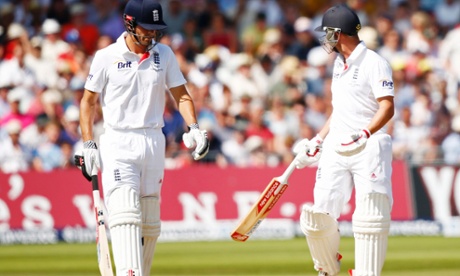
Alastair Cook - 7  Given the circus of hype surrounding the series and in particular the pressure of continuing Andrew Strauss' recent success in Ashes cricket, captain Cook could have been forgiven a nervous performance at Trent Bridge. Yet despite only scoring 13 in the first innings, he came back to score a vital half-century in the second and rescue his side from another early collapse.

As captain he continued his legacy as a calm and conservative operator despite having to manage his team through one of the most frenetic Test matches in recent years. He was also a dab hand with DRS.

Joe Root - 5  Undone by a peach in England's first innings and victim of a contentious decision in the second, Root was unlucky not to make a bigger contribution in his first outing as an England opener. He did however chip in with the ball, bagging Ed Cowan on the stroke of tea on day four to help spark a middle order collapse in the evening session.

Jonathan Trott - 6  Top scorer in England's first innings, he cruised to within two runs of a half-century only to throw his wicket away wafting loosely outside his offstump. He was, however, unlucky to be out LBW in his second outing, replays showing that the Warwickshire strokemaker got a healthy chunk of willow on the ball before it crashed into his pads.

www.guardian.co.uk

Kevin Pietersen - 6  A gritty 64 from 150 balls in the second innings made up for failure on the first morning and helped create something of a platform for Ian Bell. A gutsy knock in his first Test back after injury.

Ian Bell - 9  An important innings in so many ways, Bell's century proved to be one of the key differences between the two sides. Constructed in masterly fashion over days three and four, Bell took a conscious decision to avoid playing in the hallowed "V" and instead looked to nudge, nurdle and deflect the ball around the field, steadily accumulating runs and helping to nullify any Aussie pressure. Having already seen batsmen on both sides deceived by the slow and unpredictable nature of the surface, Bell's battle plan was little short of a masterstroke.

Jonny Bairstow - 6  Runs in both innings, he played the game at a good tempo and provided able support for Ian Bell on day three. His eagerness to play across the line of ball though continues to be his undoing.

Matt Prior - 6  Deservedly out for 0 first time out, he redeemed himself in part second time around with a useful counter-attacking display to help shift momentum England's way. Generally tidy behind the stumps he was also instrumental in England's effective use of the referral system.

Stuart Broad - 7  An impressive allround performance from Broad, he bowled with fire and accuracy to bag three vital Aussie scalps while also recording his highest Ashes score with the bat. A feisty and ultra-competitive performer, his decision not to walk in the second innings underlined the arrogance and self-belief that has helped him become a mainstay in England's ranks over the years.


Graeme Swann - 6   Four wickets in the match was not a bad return for England's jovial tweaker, but he never looked completely settled and struggled with his lengths in Australia's second innings.

Steven Finn - 4  Two wickets in two balls on the first evening remained Finn's only highlight as he was carted around by the Aussie batsman in both innings. Replaced before in an Ashes series, he looks unlikely to feature at his home ground on Thursday.

James Anderson - 10  A masterly display of conventional and reverse swing bowling, no one deserved the man of match award more than Anderson. Bowling almost 56 overs for figures of 10 for 158, he showed craft, control and endurance of the highest order to help keep his side in the contest throughout.

Friday, July 12, 2013

Bell and Broad give England control

England 215 and 326 for 6 (Bell 95*, Broad 47*) lead Australia 280 by 261 runs

Ian Bell and Stuart Broad restored some calm to proceedings on day three adding 108 runs for the seventh wicket to give the home side control at the close of play.

Bell finished the day on 95, just five runs shy of what could be one of his most important ever knocks for England. Often criticised for not making "hard" runs, Bell read the match situation perfectly and played an innings of the utmost maturity. 

It was a fine example of risk management from the diminutive Warwickshire strokemaker who took a conscious decision to avoid playing in the hallowed "V" and instead looked to nudge, nurdle and deflect the ball around the field, steadily accumulating runs and helping to nullify any Aussie pressure. Having already seen batsmen on both sides deceived by the slow and unpredictable nature of the surface, Bell's battle plan was little short of a masterstroke.
Earlier in the day all eyes had been on Alastair Cook and Kevin Pietersen. Resuming on 80 for 2 in blazing sunshine, they played out the first hour watchfully, soon guiding England to three figures. Both batsman also notched up half-centuries in the process and things were looking ominous for the tourists halfway through the morning session. However, whilst the sun had given England fans hope of a run-heavy day, the pitch was still not offering the pace and consistency that English batsman traditionally crave.

Instead the Aussie bowlers took advantage of the turgid underfoot conditions. Pietersen (64) played on after James Pattinson lured him into a risky drive outside off, and captain Cook (50) followed soon after trying to push Ashton Agar into the leg side only to close the face of the bat two early and spoon a leading edge to Michael Clarke at first slip. England precariously placed on 131 for 4, with a lead of just 67.

Ian Bell was promptly joined at the crease by Jonny Bairstow as they began to stage a mini-fightback in the afternoon session. The pair amassed 43 runs from 125 balls to help England back onto stable footing before Bairstow (15) was eventually undone by Agar, feathering one behind to Brad Haddin. Bell then shared an almost identically fruitful, yet brisker, partnership with Matt Prior (31). On this occasion it was 44 runs from 79 balls, but like before it was Bell's partner who was first to perish, the England keeper, looking to force the pace, miscuing a pull straight to midwicket.


Bell then joined Stuart Broad for what was to be the final stand of the day. First came glory as Bell reached fifty and in doing so also passed 6,000 runs in Test cricket, but then came controversy. With England sitting pretty on 297 for 6 Agar got Broad driving at a wide one which he dutifully edged to Clarke at slip. Umpire Aleem Dar though had failed to spot the deflection and Broad stood his ground. Crucially Australia had already wasted their reviews earlier in the day and, despite much protest, were forced to carry on their pursuit for yet another partnership penetrating delivery.

Wednesday, July 10, 2013

Ashes preview: Five things to look out for this summer

The Ashes summer is very nearly upon us, and with the first ball due in just a few hours, cricket buffs across the country are beginning to hypothesize about how the latest chapter in the game's oldest rivalry may pan out this year.

I've had a dig around and picked out five key things I think you should keep your eye on this summer.

Joe Root

Warmly welcomed into the England setup at the end of last year and already a favourite among the game's critics, Joe Root has fast become England's leading hot prospect.

A batsman with poise and patience well beyond his 22 years, Root exemplifies that which has made England's top order so successful in the inter-Ashes years. His debut knock of 73 from 229 balls no finer example of the composure that could see him quickly fill a Strauss-shaped void for years to come.

It is this composure too, I believe, that has seen him fast-tracked to the top of the pecking order for 10 July. Root has none of the blonde highlights and flashy off drives that made Ian Bell such a prospect in 2005. But I think interestingly it is the Yorkshireman's lack of/or ability to rein in his youthful flamboyance that has gained him favour with both cricket's inner and outer circles, and put him on the brink of an Ashes debut.

Spin

Always a topic of conversation when England meet Australia, the Aussies have arrived with just one reputable spinner in the form of Nathan Lyon and young hopeful, Ashton Agar. Oh, and Steve Smith. Secret weapon Fahwad Ahmed could still play a role too. But whilst his ascent to potential Ashes selection is almost novel-worthy, he has only played 22 professional games and hardly set the world on fire in the process.

England have named Graeme Swann as their only frontline spinner and with the series likely to be decided in swing and seam-friendly conditions it would be hard to argue for the inclusion of another specialist tweaker.

Swann's record with the ball in Ashes cricket is, perhaps surprisingly, rather modest. Three wickets per game at an average of around 40 runs per wicket are not very Swann-like returns, but what Chin crucially offers that the Aussie spinners (I believe) do not, is the ability to hold up an end and to control a match. On more than one occasion he has proven an invaluable foil to England's trio of seamers, bowling marathon spells at economy rates well below the innings average.

In the fifth Test in 2009, after taking four wickets alongside Broad in the first innings, he then bowled 40 overs in the second and took a further four vital wickets at an economy of 2.97 (England's innings average was 3.4 runs per over). Another epic performance followed down under in 2010 when he churned out a 40 over spell in the second innings of the second Test, bagging five wickets in the process at an economy of 2.21, almost a run better than the team average.

The Return of KP

An Ashes hero some eight years ago, but absent last time Australia toured England in 2009, Pietersen will be hungry to rekindle the kind of performance that saw him shoot to stardom in 2005.

His return will also bring some calm to England fans, many of which may have been fearing the potential fragility of England's batting lineup post Trott and pre-Prior, were he not fit.

He is of course an enigma, but he is more than likely to wade in with some important and no doubt entertaining runs at some point during the series. Averaging 52.71 in Ashes cricket, he is also likely to be the most talked about player in the Australian dressing room and could serve as a useful distraction for England's younger batsman as they try to establish themselves early on in the series.

The Captains

Now this is fascinating. Neither Cook nor Clarke have taken charge of an Ashes Test, yet both have excelled under the "burden" of captaincy.

They have both been imperious over the past 12 months. Clarke averaging 84.14 in nine games, scoring four centuries in the process, with Cook averaging 52.10 in 12 games with six three-figure scores to his name. Clarke's stats though are a little skewed as the majority of his runs have come in Australia where he averages well over a hundred. Conversely Cook has scored more runs abroad (New Zealand and India) than he has at home.

In terms of Ashes calibre Clarke averages 45.50 and Cook 50.56. Each have four hundreds as well. Interestingly though, Clarke averages 48.93 against England in England, whereas Cook, who averages 65.12 against the Aussies in their backyard, only averages 24.66 against Australia in England, and has yet to score a century against them on home soil.

As captains they are still both establishing themselves, however they've each proven themselves to be more than useful in charge. In terms of style Clarke is more Warne-esque and quicker to think outside the box. Whereas Cook is very much in the mould of his predecessor and happy to sit back and remain patient.

Both world-class performers, this series and the return leg down under could well make a legedn of one of these men.

Aussie bowling attack

If they steer clear of injury then Australia have a wealth of seam options. On paper all six of their plucky pacemen look to have tremendous potential, but for most that is still potential. Discounting Peter Siddle, the remaining five have just 33 Test caps between them, and James Faulkner has yet to even play a Test match. Add Ryan Harris and his injury woes into the equation and it could be a topsy-turvy series for Clarke's bowling unit.

Conditions will help though, and with England's batsman unlikely to have faced many of these young Aussie quicks, they could well have some success. However, over the course of five Test matches I think youth and inexperience may well begin show.

It will also be interesting to see how Michael Clarke manages his bowlers. In the 2010/11 series down under England made two series-defining changes to their bowling line-up midway through the tour. Tim Bresnan replaced the inconsistent Steven Finn and Chris Tremlett was given the nod as replacement for the injured Stuart Broad. Bresnan and Tremlett went on to take 20 wickets at 23 in England's victories in Melbourne and Sydney, helping England take control of the series. How Clarke manages this inevitable conundrum this summer may well be equally as pivotal.


Wednesday, August 29, 2012

Strauss retires from all cricket

England Test captain Andrew Strauss today announced his retirement from professional cricket with immediate effect.


The 35-year-old Middlesex opening batsman, who led England to two Ashes victories and the summit of the Test rankings, is retiring after 14 years in the professional game.
Strauss will be replaced as Test captain by Alastair Cook, who will also continue to lead the one-day international side.
Strauss made his England debut in an ODI against Sri Lanka in 2003 and was awarded a Test cap a year later against New Zealand, scoring a century on debut.

                                                   Strauss scores a century on debut against the Kiwis
He has gone on to win 100 Test caps, captaining the side in 50 of those matches, and also make 124 appearances in ODIs and four in Twenty20 internationals.
His international career has spanned 11 years, during which the left-handed batsman has scored 21 Test centuries and six ODI hundreds.
Strauss said: “After much thought over the last few weeks, I have decided to step down as England Test captain and announce my retirement from all forms of cricket.
"It has clearly been a tough decision to make, but I believe that it is both in the best interests of the England cricket team and myself to step down at this stage.
"There are too many people who have helped me on this incredible journey to mention them all by name, but I would like to thank all the Middlesex and England players I have played alongside, as well as the phenomenal coaches and support staff with whom I have been fortunate enough to work.
"Particular mention has to go to Andy Flower and Duncan Fletcher in that regard. It would also be remiss of me not to thank Middlesex county cricket club, the ECB and the PCA for their support and guidance over the years.
“No-one can play international cricket for any length of time without having an incredibly strong support network around them, and I'd like to take this opportunity to thank my family for going through it alongside me over the course of my England career.
“I am extremely proud of everything I have achieved as a cricketer, and I have found myself very fortunate to play in an era when some of English cricket's greatest moments have occurred.
"I have loved every minute of it and all that remains is for me to wish Andy, Alastair and the rest of the team the very best for the coming months. I will be an interested spectator."

                                                                      Strauss poses with the Ashes urn
David Collier, ECB Chief Executive, commented: “On behalf of the ECB and everyone involved in cricket, I’d like to thank Andrew Strauss for his outstanding contribution to the game.
“Andrew has been a highly successful captain and opening batsman for Middlesex and England, who will be remembered for leading the side to two Ashes victories and to the top of the Test rankings.
"He has shown tremendous integrity, dedication and commitment both on and off the field and under his leadership the side has grown immeasurably and reached new levels of professionalism.
“Andrew’s calmness and authority when dealing with some of the most difficult moments in our sport in recent times should be applauded and I have no doubt that his contribution as an ambassador for the game will be recognised by anyone who has had an opportunity to spend time with him.
"His legacy within the game will be felt for many years to come and we now need to continue to build on the progress we have made under his leadership.
“I would like to congratulate Alastair on becoming Test captain. He has shown he has the traits needed to be a successful captain and has demonstrated his leadership capabilities as one-day captain over the last 16 months.
"On behalf of the ECB I would like to wish Alastair and Andy Flower all the very best for the exciting challenges that lie ahead.”


                                            Alastair Cook will take over from Strauss as England Test captain
Cook said: “Andrew’s contribution to England cricket in recent years is evident to everyone who follows the sport, but only those of us who have been lucky enough to share a dressing room with him are fully aware of his immense contribution to our success.
"He has been a fantastic captain, has led from the front for three and a half years and is a true ambassador for the game.
"To have played 100 Tests for your country is a phenomenal achievement and I want to congratulate him on a superb career.
"I know this can’t have been an easy decision for him and everyone in the dressing room will be sad to see him go.
"I’m very excited by this new challenge; it is a huge honour to be appointed Test captain and I am very much looking forward to captaining the side in India this winter and beyond, but my immediate focus is on this current NatWest one-day series.
"Once the series is over I will turn my attention to the Test captaincy and building on the work Andrew has started.”


ecb.co.uk
image
image
image

Monday, January 09, 2012

The best of the Test: My Test team of 2011

It has been an intriguing twelve months for Test cricket. Amid fears for the health and longevity of the game’s premier format, 2011 churned up some of the most exciting and hotly contested cricket in recent years. England destroyed almost everyone in their path on the way to becoming world number one, Australia and South Africa shared the spoils in perhaps the greatest two match series ever, Sri Lanka won their first Test in South Africa, and India and the West Indies helped record only the second ever scores level draw in the history of Test match cricket. And that really is just the beginning.

In and amongst such drama though was of course plenty of individual brilliance and with the 2012 now finally underway it seems only appropriate to indulge my inner schoolboy and compile my ultimate Test XI for 2011. 
Are you in agreement?

Alastair Cook 927 runs at 84.27. Without a doubt the stand out batsman of 2011, Alastair Cook has gone from strength to strength since his extraordinary end to 2010. He began the year by adding a magnificent 189 in the final Ashes Test in Sydney to take his series total to a mammoth 766 runs before notching up a further 390 runs in three Tests against Sri Lanka including two centuries and a 96. If that was not enough, Cook rounded off his landmark year by crafting a career best 296 against India as he helped England ascend to number one in the world.


Rahul Dravid 1145 runs at 57.25. One of only two batsmen to score over 1000 runs in 2011 Dravid succeeded where many of his Indian colleagues failed. A match-winning century against the West Indies in Jamaica in June was only to be outdone by three back-to-the-wall hundreds in England as he proved himself to be a class above the rest of India’s old boys.

Hashim Amla 423 runs at 47.00. A curious choice perhaps with the likes of Jacques Kallis and Sachin Tendulkar not included despite boasting more prolific records, but Amla’s performances, especially against Australia, earn him a deserved place. A 195 run partnership with captain Graeme Smith in the first Test in Cape Town proved his calmness under pressure after both teams had been dismissed for less than 100 runs in previous innings, and despite losing the second Test in Johannesburg Amla’s five and a half hour 105 in the second innings ensured that the match went down to the wire. A man for the big occasion no doubt.

Kumar Sangakkara 1034 runs at 49.23. The number one Test match batsman according to the ICC Test rankings and the second most prolific run-getter in 2011 Kumar Sangakkara continued to demonstrate his class against the world’s best. Sri Lanka plied their trade against stiff opposition in 2011, travelling to England and South Africa as well hosting Australia and playing Pakistan in the UAE. However, despite only one Test victory all year Sangakkara emerged as imperious as ever bagging three hundreds and a double ton to help his team remain competitive throughout.

Ian Bell 950 runs at 118.75. Rid of his boyish insecurities Ian Bell has flourished into a Test match batsman of unrivalled class. Always stylish but not always prolific, Bell’s hunger for runs has made him into a seriously effective cricketer. A maiden Ashes hundred at Sydney was followed by two unbeaten centuries against Sri Lanka, before a gorgeous 159 against world champions India at Trent Bridge. His defining innings though came in the final Test of the summer. Batting at number three in place of the injured Jonathan Trott, Bell scored a magisterial 235 to help England complete another innings victory and seal a 4-0 series whitewash. Sheer class!


Darren Bravo 949 runs at 49.94. Lofty comparisons with cousin Brian Lara are perhaps a little premature, but there is no doubting that if the West Indies are to return as a genuine force in world cricket then the continued success of Darren Bravo is paramount. Having to wait nine Test matches before recording his first century Bravo eventually reached three figures in style bagging a greedy 195 against Bangladesh this October. Two further centuries quickly followed against India, his total haul of 214 in Mumbai proving pivotal in a famous score draw.

Matt Prior 519 runs at 64.87, 34 catches, two stumpings. It has been a career-defining couple of years for Matt Prior who, provided Sangakkara doesn’t decide to re-don the gloves, now stands as arguably the world’s best keeper-batsman. Batting at number seven, Prior’s selfless attitude to batting and willingness to marshal an admittedly very capable tail has made him an indispensable part of the England set up. A century in all three of England’s Test series in 2011 only represents a fraction of his contribution.

Stuart Broad 33 wickets at 22.30, 239 runs at 39.83. Having missed most of England’s tour of Australia through injury and with the emergence of Tim Bresnan and Chris Tremlett as his replacements during that victorious Ashes campaign there was at least a smidgen of pressure on Stuart Broad to hit his straps in 2011, and that he did. In four Tests against India Broad averaged over 60 with the bat as well as taking mammoth 25 wickets at an average of just 13.84.


Dale Steyn 28 wickets at 19.57. Still undoubtedly the world’s most consistent and potent fast bowler, Dale Steyn had yet another year to remember in 2011. Steyn took five wickets or more in all five of South Africa’s Test matches last year, which included bouts with India, Australia and Sri Lanka. His battle with Sachin Tendulkar in Cape Town perhaps the year’s greatest cricketing confrontation.

Saeed Ajmal 50 wickets at 23.86. The leading wicket taker in 2011 Saeed Ajmal helped Pakistan complete a year of much-needed consolidation after continued controversy throughout 2010. His best haul of 11 wickets came in a losing cause against the West Indies, but he went on to lead the attack and help his team to victories over Zimbabwe, Sri Lanka and Bangladesh. Sterner tests await in 2012, however with an as-yet unseen “mystery ball” ready to be unleashed the world’s top teams will have to treat him with respect.

James Anderson 35 wickets at 24.85. Now officially the spearhead of the England attack, James Anderson hardly bowled a bad ball in 2011. Seven wickets at Sydney capped off an exceptional Ashes series for The Burnley Express, and after a steady couple of outings against Sri Lanka Anderson once again turned on the magic taking 21 wickets against India in four Tests and terrorising Sachin Tendulkar with a master class in swing bowling.  

Tuesday, November 29, 2011

Cook and Strauss in all male SPA shortlist

England captain Andrew Strauss and vice-captain Alastair Cook have been shortlisted for the 2011 Sports Personality of the Year Award.

Strauss and Cook have been integral to a magnificent year for English cricket. A thumping victory in the Ashes down under was followed by an equally impressive 4-0 whitewash of India on home soil this summer, a result that meant England would begin 2012 as the world's no. 1 Test team.

After a poor run of form in the summer of 2010 Cook was a man under pressure, but with 766 runs in five Ashes Tests and 294 against India this summer - the sixth highest score by an Englishman and the best since Graham Gooch's 333 against the same apposition in 1990 - the elegant Essex opener proved he was here to stay.

He was duly rewarded with the One Day captaincy and went on to preside over series victories against Sri Lanka and India, all the while contributing handsomely at the top of the order. A 5-0 defeat in India at the back end of the summer reminded Cook that captaincy could not be taken for granted, but having overcome obstacles in his short career so far it would be no surprise if Cook returned with aplomb in 2012.


As Test captain however Andrew Strauss's success has almost been untainted this year. Unbeaten in their last nine series Strauss has given England the kind of stability and calm that they needed after the disastrous series in the West Indies in 2008.

In 2011 Strauss masterminded an astonishing Ashes victory in Australia and helped England to their first whitewash over India since 1974. In partnership with Andy Flower, Strauss has helped mould England into a prolific and highly professional unit who will once again be looking to assert their authority over world cricket when they face Pakistan and Sri Lanka this winter.

Thursday, October 13, 2011

Master's of all trades: A bright future for English cricket

Over the past two decades cricket has been blessed with a handful of truly extraordinary performers. Yet it seems that as we enter the second decade of the new millennium that these once-in-a-generation superstars are now all but absent from our beloved game. Gone are Warne and McGrath, Ambrose and Walsh, Hayden and Langer and in their place a new breed of cricketer, the modern day allrounder.

Now don't be fooled. This new crop of talent are not, perhaps regretably, all budding Ian Bothams, Imran Khans, or, dare I say it, Andrew Flintoffs. They are not extroverts, nor sticklers for controversy, but rather normal, law-abiding professionals whose exploits tend to remain on the back rather than the front pages of the now presumably disinterested press. They are however slowly paving the way for a new era in international cricket, and one I'm happy to say is being led by the English.

So, what is this new 'all-rounder' I speak of? Well, in the absence of what Geoffrey Boycott would call truly 'great players', and with international cricket now played regularly across three different formats, cricketers are becoming increasingly aware of the need to diversify beyond the confines of their chosen specialty if they are to remain a permanent fixture in their team. This, as was evident with the Indian team this summer, is a mantra more readily embraced by some nations than others.

The hard truth is that unless you bowl at 95 mph, average over 50 runs per innings or turn the ball both ways then you can no longer rely on your primary trade, be it batting, bowling or wicketkeeping, to keep you in cricket's elite.

As the world's premier test nation, Ashes holders and World Twenty20 champions, England, it seems, have bought into this new philosophy of utility cricket more than most. Having watched with great interest, and at times a surprising amount of jubilation, England's ascent to the peak of the game ever since the disastrous series in the Caribbean in early 2009, I think it now time to reflect on why England's band of multi-talented cricketers have got this far.

Lead by example
If asked who more than most was responsible for England's rise to the top few would give Peter Moores any real consideration. Yet whilst his tenure as England coach may have been marred by scandal leading to his eventual dismissal in early 2009, he was to make one decision that would prove pivotal to England's subsequent success - Andy Flower.

Having employed Flower as batting coach at the national academy in 2005, Moores went on to appoint him his assistant when he took charge of the England team some two years later. While Moores' impact as a coach may have been generally uninspiring, his recognition of Flower's talents would be crucial to England's longevity as a top flight team. Taking over temporarily after Moores' departure, Flower eventually agreed to take the job full time, and despite a sticky start in the Caribbean England has never looked back since.


Alongside Andrew Strauss, Flower has taken an approach quite unique from that of his predecessors. With little support from cricket's 'old boys'  he has set about creating a squad of professionals whose value is measured by their all-round performance rather than a player's reputation; a welcome departure from the narrow-mindedness that haunted England after the 2005 Ashes.

It is an approach that no doubt stems from his own experience as a cricketer. A world class wicket-keeper batsman and also national captain not too long ago, England's 'team director' knows full well the importance of cricketers who can contribute beyond their primary trade, and after nearly three years in charge his work is starting to pay off. England's bowlers now field better than almost entire sub-continental teams, Prior has elevated himself to perhaps the best wicket keeper batsman in the world (now Sanga has hung up his gloves) and England no longer have any genuine tail-enders. Flower has not only hand-picked a world-beating side but has developed an effective and lasting ethos that could see England at the top of the international game for many years to come.

Staying in shape
One of the marked changes to English cricket under Andy Flower has been to make cricketers into athletes. Over the years and largely thanks to exercise-resistant commentators like Sir Ian and Lord Gower, there has been an ongoing debate as to whether cricketers are perhaps over-trained. With new dietary regimes, team building weekends and even in-house psychologists many of cricket's stodgy elite have rubbished England's decidedly alcohol-free approach to match preparation. Once again though they couldn't be more wrong!

With the help of fitness fanatic Graham Gooch, Flower has created a team of lean and powerful cricketers whose physical prowess has been a deciding factor in recent times. Even Australia, whose penchant for fitness has been at the heart of their success for years, had to tip their hat to England this winter as they were made to toil in the heat for days on end as the likes of Cook and Trott pilled on the runs. Meanwhile the likes of Broad and Anderson had their feet up on the balcony fresh to rip through the Aussies as and when England decided they'd had enough.

Even against India this summer, who on paper looked a fine match for the home side, England's stamina and focus ultimately proved the deciding factor between the two teams. Indian players were sent home injured and England never took their foot off the pedal. Whilst fitness levels may only give a team an extra five per cent in a one day match (India's love-affair: IPL), over the course of Test series teams can find themselves quickly out of touch with their rivals if they are not physically prepared.


England though are cautious not to expect too much from their players, and whilst they firmly believe that players who contribute to all areas of the game are truly valuable commodities, they also understand that, especially considering English cricket's jam-packed schedule, it is not realistic to expect the same eleven players to perform at the same level all the time. As a result England management have introduced the strengthening and conditioning programme, giving players the opportunity to rest their bodies and to work on their core fitness for when they return to the team. Another example of staunch traditionalists eating their words the programme has been and continues to be a resounding success, and the resting of players like Steven Finn, James Anderson and Kevin Pietersen has helped England keep key players fresh and develop new and exciting prospects, especially in the longer form of the game.

Team Spirit
England more than most are a team who want to do things for each other. They enjoy one another's success and they work as a team. Whereas Andrew Flintoff tried to (and often did) do everything himself this current England team whilst brilliant individuals combine to create a truly all-round team motivated not just by their own performance but by the efforts of others.

Never does an England player in a post-match interview heap the praise on himself. Whilst it may be dull for those writing about the team, each and every player always takes time to congratulate the team effort and to express their delight that, despite having taken five wickets themselves, it is all the better only for the overall team performance. There is a sense of democracy about England at the moment. There is no great void between younger and older players, or one player propping up the team all the time, instead each player recognises that they can make a contribution and crucially that, however small, that contribution is valued.


To be an 'all-round team' a feeling of togetherness is essential, this means both on and off the field. Freddie's pedalo for example may have found England cricketers pushing the boat out a little too far in their spare time, but a few years later and Graeme Swann's Ashes diary seemed to have quite the opposite effect. Providing a hilarious but also encouraging insight into the England team's after hours shenanigans Swann's tapes revealed a team enjoying each other's company and a team spririt that has helped England team become the epitome of modern day all-rounders.

Sunday, November 21, 2010

Cook hits timely ton in England draw


South Australia 221 & 2 for 48 drew with England XI 8 for 288 dec & 1 for 240 dec (Cook 111*, Strauss 102)

An uncanny ability to rescue an international career from troughs of unimaginably poor form with match-winning knocks under the most immense pressure has epitomised Alastair Cook's cricket over the last two years. While his neck may not quite have been on the line in this second warm-up game against South Australia, England confidently opting not to bolster their squad with a third opening batsman, it would be hard for any England fan who has followed the Essex stroke maker this summer to say with some conviction that a solitary ton amongst a handful of failures is enough to ensure a return to the consistency that typified his first year as a Test match batsman.

Three days earlier Cook had been given his first chance to silence the critics, England winning the toss and electing to bat first. But after an assured start he decided to delay his batting epiphany for another two days and instead gift Peter George his third wicket of the day to reduce the visitors to 63 for 3 on the opening morning. Kevin Pietersen soon followed caught off the bowling of Queensland paceman Ben Edmondson by the magnificently named Aiden Blizzard leaving England in need of some plucky resistance in the afternoon session - enter Paul Collingwood.

An uncharacteristically fluent innings from Collingwood on the ground where he crafted his highest ever Test score guided England to 226 for 4 before, six runs short of a hundred, he edged a Jake Haberfield delivery to a grateful Callum Ferguson in the gully. Ian Bell powered on for another six and a half overs taking his side past 250 and himself past 50, and with a declaration now imminent Matt Prior and Graeme Swann chipped in with brisk cameos to propel England to 288 for 8 declared in just over 78 overs. In turn Strauss was afforded the luxury of unleashing his trio of youthful seamers on a weary South Australian opening pair, but some steadfast defensive play ensured the home side suffered no casualties come the close of play.

Day two began promisingly for England, Stuart Broad making the breakthrough at the end of his second over of the morning drawing James Smith into edging the ball through to wicketkeeper Matt Prior. James Anderson then bagged opener Daniel Harris with the first ball of his over to make it two wickets in two balls for the tourists. A spirited South Australian middle order fightback kept them afloat until Michael Klinger wofted his bat at a James Anderson delivery only to spew the ball into the grateful hands of Kevin Pietersen and spark a mid-innings collapse.


Anderson continued his impressive work removing wickie Graham Manou for 0, but it was England's premium tweaker Graeme Swann who caused the most damage taking four of the final five wickets to skittle the state side out for a lowly 221 and finish with figures of 22.4 overs, 4 for 68. 


England returned to the middle for the majority of the evening session to cap off an impressive day for the touring side. Strauss and Cook taking England to 94 without loss at stumps and a lead of 67 going into the final day. The captain was in particularly imperious form hitting three sixes and five fours in his 56 not out, reaching his fifty at almost a run a ball. With Cook and Pietersen now in competition for least-assured batsman in world cricket, Strauss's new-found penchant for the boundary rope and even the spectators stand has provided fans with renewed optimism as to the dynamism of England's top order.


There was little respite for the home side come day three too and Cook and Strauss both kicked on at a pace. As Cook passed fifty Strauss was closing in on another century making light work of the South Australia attack hitting the ball to all parts. His inevitable century was only marred by a switch dismissal shortly after, but 102 from just 121 deliveries meant his Strauss's innings was sure to be the talking point well beyond the stands in Adelaide.


Backed up by Jonathan Trott, Cook too cashed in on the final day and his 111 not out, including 18 fours and a six, will have gone some way to relieving the pressure that had begun to build after scores of 5, 9 and 32 in his three innings on the tour so far.


A rain interrupted afternoon meant England's bowlers were unable to forge any hopes of a victory, but two wickets for Jimmy Anderson proved once again that the man from Burnley may well have a bigger part to play in this series than some narrow-minded critics are suggesting.


All in all a very worthwhile outing for what appears to be still a very polished pom outfit. Every bowler grabbed a scalp despite limited opportunities and England were a class apart with the willow. A slight concern still hangs over Kevin Pietersen who was denied a second bite at the cherry this time around, and one can only hope that the frighteningly predictable nature of Alastair Cook's batting record does not become the subject of some smart-arse statistic relayed by one of Sky Sports' increasing smug Hollywood Elite!

Tuesday, September 28, 2010

Bangladesh in England Test Series 2010

England v Bangladesh, 1st Test at Lords, May 27 - 31, 2010.

England 505 (Trott 226, Hossain 5-98) & 163 for 2 beat Bangladesh 282 & 382 (Iqbal 103, Finn  5-87) by 8 wickets.

On the Front Foot
Jonathan Trott has had a topsy-turvy nine months since his Ashes heroics last Summer, but with his feet back on familiar shores Trott picked up where he started off with his maiden Test double ton and his second hundred in three innings in England.  His 226 took England to an imposing 505 all out allowing Strauss to eventually enforce the follow on and lead his team to an eight wicket victory. Often criticised for his laborious manner at the crease Trott proved the glue to England's innings kick-starting his summer in the best way possible.


All Edge and No Middle
After a fine series as captain against the Tigers away from home Cook found little luck in the first Test. He was the only England batsman to be out for single figures in the first innings adjudged lbw off the bowling of Shahadat Hossain in the fifth over of the game. As it turned out Cook was unlucky to be back in the dressing room so early, hawkeye suggesting the ball would have gone over the stumps. Four days later and with England chasing 160 runs to win the Test match Cook was again trapped in front this time by Mahmadullah only for replays to reveal the ball would have flew over off and middle!

Line and Length
Five days and nine wickets later and Steven Finn is odds on to board the plane to Australia. A mechanical bowler with a conservative action Finn lets his bean pole stature and ice cool temperament do the talking. Unlike England apprentices before him who have reaped the rewards of overcast conditions or green top wickets Finn relied on persistence and skill for each of his nine wickets. In the first innings he bowled 25 overs  for four of the top seven wickets prising out genuine edges once to Strauss at first slip, and twice to Prior, before clean bowling Rahim as Bangladesh refused to play to any stereotypes and needlessly give their wickets away.

With Bangladesh following on Finn was straight back into action charging in for another 24 overs in total this time getting himself on the Lords honours board claiming a much-deserved 5 for 87. After ending Tamim's onslaught Finn went about plying his trade with great skill. Whilst plugging away outside offstump Finn used subtle variation on a wearing pitch to keep the Tigers in check and completely outclass his fellow bowlers who amassed 86 overs and 274 runs collectively for the loss of the remaining five batsman.


Adrenaline Junkie
England's eight wicket victory whilst deserved was certainly not as easy an affair as they may have expected, and one man that will not be forgotten by the Lords crowds is Tamim Iqbal. His blistering 103 in 100 balls quickly prompted comparisons with Virender Sehwag and as the feisty left hander dispatched England's pace attack to all parts the likes of Broad and Bresnan may have been wishing they were bowling to the Indian opener.

Tamim's all-guns-blazing attitude to batting though is in reality a pragmatic approach to playing for Bangladesh, who one suspects will not get very far trying to grind out results, they're simply not in the same league as the world's best. Unfortunately while a blazing hundred in a one day game may be able to alone win the odd game, a moment of such brilliance in the context of a five day match will more often than not fail to sway the final result when your team mates lack your god-given talents.


England v Bangladesh, 2nd Test at Old Trafford, June 4-6, 2010.

England 419 (Bell 128, Al Hasan 5-121) beat Bangladesh 216 (Iqbal 108, Swann 5-76) & 123 (Finn 5-42) by an innings and 80 runs.

Anchor
At 153 for 4 the England innings could have gone one of two ways, Ian Bell made sure it went the way all home fans were hoping for. Batting for five and a half hours he absorbed early pressure and then went about bisecting the Bangladeshi fielders with the kind of maturity he has shown in the past 12 months. Ably assisted by Matt Prior (93) Bell took his side to 376 for 5 before he was unlucky to fall victim to a wonder delivery from Shakib Al-Hasan that gripped sharply off the surface making a mess of the batsman's stumps.

It was the temperament of 'The Sherminator's' knock that was most telling, the man who once only scored hundreds when in the company of other centurions and who had been heavily criticised for getting out when well set was now leading his team into a winning position. If his marathon innings against South Africa was an indication of his new found maturity this was confirmation of his continual importance in the England middle order.

Unlikely Hero
While Bell and Prior were piling on the misery for his team Shakib Al Hasan the Bangladesh captain took it on himself to try and inspire a breakthrough. A thoughtful bowler Shakib has already taken six five wicket hauls in Test cricket at a healthy average of just over 30. It so happened that his hard work payed off and he was rewarded with the wicket of Ian Bell albeit against the run of play. The ball darted in to leg stump bell pushed at it expecting to be able to guide the ball into the leg side, instead the ball gripped and spun viciously to miss Bell's bat flick the off bail.

That bit of magic proved decisive as 376 for 6 became 419 all out, the captain causing the majority of the damage and picking up a hard earned five-for, his final figures reading 37.3 overs, 5 for 121 with three maidens.

Lone Ranger
Another lost cause, another outstanding innings, Tamim Iqbal's refreshing attitude to batting and abislity to rack up substantial scores from ball one has elavated the 21 year old to cult status as of late and his second century in as many matches has simply put the cherry on the cake.

108 from 114 balls was the equation this time around, exactly half of the Bangladesh total score. It wasn't enough to save his team but that was never the point Tamim is not selfish or unruly as many may presume he is a realist and his inspirational approach to batting is a lesson to all.


The Turning Point
The most improved cricketer in world cricket, it rarely comes as a surprise nowadays when Swanny bags a five-for, and that was exactly what he did after Anderson had the dangerous Tamim caught behind. Siddique was too easy for Swann his impatience his undoing eventually succumbing to Swann's immaculate line and length and edging to Prior. Islam was next to go, lured into wafting outside his offstump only to mistime his drive and gift Swann a classic offspinner's dismissal gripping and turning and crashing into the middle stump.

The rest was childsplay for a man of Chin's quality and as his fingers rolled over what was to be the final cherry of the Test Hossain was trapped on the crease and swiftly adjudged lbw by the crooked finger of Billy Bowden, game, set, match!


Saturday, July 03, 2010

Bangladesh v England, 2nd Test, Dhaka

England 496 (Bell 138, Bresnan 91, Shakib 4-124) & 209 for 1 (Cook 109) beat Bangladesh 419 (Tamim 85, Swann 4-114) & 285 (Shakib 96, Tredwell 4-84) by 9 wickets


Day One


The first day of the second test in Dhaka was a strangely disappointing affair as both England and Bangladesh struggled to get a strangle hold on the match. The hosts failed to capitalise on a flat, lifeless wicket, whilst England were never able to maintain pressure on the Bangladeshi batsman, and quickly ran out of ideas as to how to contain a certain Tamim Iqbal who's reputation as a no-holds-barred opening batsman has sky-rocketed in the last few months. His 85 from 71 balls propelled the Tiger's to 119 for 1 before an attempted sweep off debutant James Tredwell appeared to clip Tamim's glove en route to a grateful Matt Prior behind the stumps, replays showed it may well have only glanced his forearm but thankfully for England the decision stood.

Debutant James Tredwell was fortunate to end 
Tamim Iqbal's domineering knock
Image courtesy of cricinfo.com

After a scorching start Bangladesh began to totter as the ever-reliant Graeme Swann trapped Jahurul Islam in front LBW leaving Shakib's men delicately poised on 122 for 3. But the tourists were unable to take advantage and wickets became less frequent throughout the afternoon session, Junaid Siddique constructing a useful 39, whilst the versatile Mahmudullah passed his half-century with ease only to be undone by Stephen Fin in the first ball of his spell. The captain Shakib Al-Hasan fell one short of a half-century of his own and Mushfiqur Rahim the Bangladeshi wicket-keeper dug in with Naeem Islam for 30 off 83 balls, but having shown such promise in the first test it was a shame to see the little man not launch some sort of counter-attack whilst the pitch was at its best.

Ultimately it was the hosts inability to convert decent chances into big substantial innings that haunted them throughout the days play. So often blown away at the top level, almost all of Bangladesh's batsman got their eye in only to loose concentration and throw their wicket away. Equally England only really found momentum in the final session having never been able to effectively pressurise the opposition in the field. Cook seemingly unwilling to take a risks and instead happy to move through the motions opting for defensive fields when England were in need of a breakthrough, rather than chancing his arm. All things said a gritty final session saw Cook's men restrict Bangladesh to 330 for 8 overnight,  and considering Tamim's fireworks and the dire state of the pitch England would have no doubt been satisfied with their days work.

Day Two


Day two was in fact shaded by Bangladesh, who resuming on 330 for 8 were finally bowled out for an admirable 419 thanks to half-centuries from Naeem Islam and Shafiul Islam. The two Islams shared a stand of 74 as England's bowlers failed to get into their stride early on, the two batsmen proving useful foils for one another as Shafiul threw caution to the wind, whilst the more experienced Naeem kept the English fielders on their toes rotating the strike and frustrating the tourists. Unsurprisingly Shafiul was the man to fall first shortly after registering his maiden Test match 50, but the toil continued for Cook as a 31-run tenth wicket partnership between Naeem and Rubel Hossain saw Bangladesh pass 400. However with the pitch still flat and true Bangladesh would still have to work extremely hard to dislodge England's top order who had already enjoyed milking their bowlers for big runs only a week before in Chittagong.

A wagging Bangladeshi tail left the likes of Steven Finn 
with their heads in their hands for much of the morning
Image courtesy of cricinfo.com

As it turned out the Tigers soon found themselves in a tidy position thanks to some indifferent English batting and determined bowling by the likes of Rassak and Hussain. After a fluid 21 it was Cook who was first back into the changing rooms oddly deciding to slop-sweep Abdur Razzak only for the England skipper to pick out Imrul Kayes at midwicket. With KP at the crease Shakib opted to use both of his left-arm spinners in tandem hoping to once again undo England's foremost stroke-maker. For a while Pietersen was equal to the task and he soon past 5,000 Test runs, but following a succession of maidens and marginal decisions that went the batsman's way he was undone by his old nemesis. Yes it was Shakib's left arm tweakers that induced a leading edge from England's No.3 and Kayes bagged his second catch of the match at short cover. When Paul Collingwood succumbed to the reverse swing of Hossain Bangladesh were firmly in control and the tourists were in real trouble at 107 for 3.

A dogged unbeaten 64 from Jonathan Trott ensured that English blushes were not quite as rosy and at stumps England had managed to grind their way to 171 for 3. The day though remained to Bangladesh who comfortably passed 400 to amass an unlikely first innings total of 419, and then carried their momentum into the field exercising their plans well and not allowing England to score as freely as they had done before.

Moreover Cook's inexperience as captain was finally beginning to show as he chopped and changed in search of what he considered the 'inevitable' final two wickets. But with the likes of Andrew Strauss, Michael Vaughan, and Graham Gooch overseeing the progress of the new-look England team, Cook has unrivalled access to some of England cricket's steeliest characters.

Day Three


Following a timid display by England on day two, Cook and his men were aiming to finally stamp their authority on a game that had yet to serve as an inspiring advertisement for Test match cricket. Early signs though were not encouraging. Jonathan Trott unfortunate to be, but ultimately dismissed in only the third over of the day by Shakib Al Hasan who had the forearm of England's gritty opening batsman to thank for the removal of Trott's off-stump. Consequently England were left in a fragile state and their hopes of a 2-0 whitewash well and truly in the balance.

It was up to Ian Bell to breath some life into England's innings, and it was a typically classy 138 that guided the tourists to a slender lead at the close of play. What was most fascinating about Bell's knock was that as he recorded his 10th Test hundred it was the first time he had past three-figures without a team-mate doing so before in an innings. No longer the accomplice Bell became his team's anchor and managed to inspire the likes of Matt Prior (62) and Tim Bresnan who finished the day unbeaten on 72 to avoid any England blushes. No doubt there will be sterner tests ahead for Bell this year, not least this winter, but it still remains a telling statistic, and may well be a sign that Bell is ready to take on the responsibility of putting together match winning scores in the middle overs in the hope of cementing a spot in England's Ashes squad and beyond.

Mushfiqur Rahim shakes the hand of Ian Bell after a majestic ton on Day Three
Image courtesy of cricinfo.com

Aside from Belly's heroics luck remained in the batsmen's side with decisions regularly going against Bangladesh and it was not long before Shakib was dragging himself around the field, a feeling of dejection that soon spread to the rest of the hapless Tigers and even the Bangladesh coach Jamie Siddons. Siddon's frustration was understandable and he lost his cool or more than one occassion, firstly charging into the umpire's room, and later when an LBW appeal against Bell was turned down, he was seen gesticulating at the boundary edge. Whilst one could sympathise which Siddons's frustration it was hard to see that at such a crucial stage in the Test match that a writhing coach on the sidelines was to going to provide Shakib's men with much-needed inspiration.

However, England's lead remains slender and if the Bangladeshi bowling has proved anything it is that their are few demons in this pitch.With the dangerous Tamim Iqbal eager to clear the ropes from ball one, Cook will have to remain patient and be more canny with his field placements with Graeme Swann and James Tredwell likely to be rolling poles for much of day four as England look to capitalise on a dogged days work with the willow in hand.

Day Four


Continued determination with the bat and an impressive outing with the ball saw England take charge on the fourth day in Dhaka. Resuming on 440 for 8 Bresnan and Tredwell shared a useful ninth-wicket partnership of 47 before the latter fell for 91 trying to loft Abdur Razzaq back over his head, only to be undone by some sharp turn on a wearing surface. The uncharacteristic 'dance' down the wicket from the Yorkshireman  though seemed to spark the tourists into life, and a brace of boundaries by Tredwell off Shakib, who amassed a titanic 66 overs in England's second innings, propelled his side to 496 all out.

Tim Bresnan fell agonisingly short of a maiden Test century
Image courtesy of cricinfo.com

As expected Cook quickly 'turned' to his spinners and Tredwell was unfortunate not to have Tamim back in the shed early on. The enterprising opener was given all of three lives, first Prior unable to gobble up a fairly straightforward edge behind the stumps, Tredwell himself was then guilty of fumbling a caught and bowled opportunity with Tamim on 26, and it was not before another catch had gone wanting that Swann finally removed Bangladesh's wonderkid, slashing the offspinner to Stuart Broad at point.

Despite missed opportunities England continued to ride their luck. Imrul Kayes bowled after the ball ricocheted off his thigh pad and onto the stumps, and soon after Junaid had got quietly into his stride he somehow managed to cut a Tredwell delivery straight onto the Cook's boot only for the ball to loop back to spinner who gratefully took the most peculiar of caught and bowled.

Bresnan's career best batting figures did little to compromise his bowling, the bustling seamer managed to swing the ball both ways with ease, and it was not long before he snuffed out the talented Mahmadullah taking a thin inside edge as Bangladesh slipped to 130 for 4. A slip soon became a slide thanks to a peach from Graeme Swann completely deceiving Jahurul with dip and grip managing to dart his offspin untouched between bat and pad.

130 for 4 became 156 for 5 and not long after 169 for 6, with only a further three runs added before the bails were removed. Bangladesh's inability to move up through the gears, either getting bogged down in first or skipping directly to fifth, cost them dearly and their immaturity in the longer format was evident. Ploys that have seen Bangladesh become a competitive force in One Day International cricket will never prove fruitful in Test cricket, and this will be a lesson that Shakib's army of youthful cricketers will have to learn before too long.

Day Five


England maintained there one-hundred percent record over Bangladesh with a seemingly comfortable victory over the test minnows in the second and final test in Dhaka. The two captains provided the main talking points throughout the final days play that saw England cross the line, albeit amongst another spirited Bangladesh batting performance.

Having tottered to 172 for 6 yesterday much, in fact almost everything rested on the shoulders of the Tiger's captain Shakib Al Hasan, and he did not disappoint. As his team-mates crashed around him Shakib very nearly guided his team to safety. The birthday boy combined well-timed flourishes with dogged defence and almost put his side on the brink of an upset as he looked to take as much time out of the game as possible. Tragically one shot away from a majestic ton he lost his cool and ran down the wicket to Tredwell attempting an enormous swipe only to hit thin air and be stumped for 96. The manner of his dismissal was typical of Bangladesh's cricket this series, and the naivety that they continue to play with despite possessing raw talent that many well established Test nations would envy.

Alastair Cook finished as the leading run scorer in a victorious series for England
Image courtesy of cricinfo.com

Plaudits must remain with England though, and after a sketchy series in charge, Alastair Cook ensured that there was little doubt as to his calibre as his country's gritty first choice opening batsman. He finished as the leading run scorer in the series with a career-best 173 in Chittagong, and his unbeaten 109 on the first day in Dhaka ensured that England's victory in the end at least appeared comfortable. A dejected bowling display by the likes of Shaiful Islam and Abdul Razzak gifted the tourists an easy start, and Pietersen joined forces with his captain crafting a sumptuous 74 not out to see England cruise to a nine-wicket victory and a 2-0 series whitewash.

Saturday, June 05, 2010

Bangladesh v England, 1st Test, Chittagong

England 599 for 6d (Cook 173, Collingwood 145) & 209 for 7d beat Bangladesh 296 (Tamim 86, Swann 5-90) & 331 (Siddique 106, Swann 5-127) by 181 runs.

After a positive result in the one-day series England were looking to continue their good form into the longer format marking the beginning of their preparations for the eagerly anticipated Ashes series this winter. With Andrew Strauss still on a much-deserved break from test cricket Alastair Cook was given his first chance to captain his country in the five-day game. And it was changes all-round as England brought in two fresh faces for their opening match in Chittagong, Michael Carberry would get a long-awaited chance filling in for Strauss at the top of the order whilst young Stephen Finn, a 6ft 7 giant from Middlesex would try to prove himself in less-than-familiar conditions.

Day One

Whilst Cook's chance to captain England would be inevitably short-lived he did his chances of one day leading his country no harm on the first days play, as himself and Kevin Pietersen piled on the runs in the sub-continental heat. Finishing on an unbeaten 158 Cook provided the backbone for his side as they closed on a 374 for 3. Earlier Pietersen had amassed a well crafted 99 only to be undone by his nemesis, the left-arm spinner, but alongside Cook they marched England into dominant position.

Despite Cook becoming the fifth England batsman to score a century in his first match in charge, it was Shakib Al-Hasan, the Bangladesh captain that caused the major talking point. On a pitch that looked certain to deteriorate as the game progressed Shakib unfathomably opted to field giving the English batsman the chance to post a handsome first innings total. The obvious lack of confidence showed by Shakib did little to inspire his bowlers as they toiled throughout most of the day and England profited from some decidedly ordinary test match bowling. So England stood pretty after day one and even at this early stage it seemed that Bangladesh would be chasing the game from here on in.

Alastair Cook enjoys a dream-start to his first stint as 
captain with a well-crafted century on Day One
Image courtesy of cricinfo.com

Day Two

Moments of inspiration from the hosts on day two were overshadowed by another authoritative display by England. Cook was unable to reach his double-hundred (a statistic that continues to haunt England's batsmen) pulling a ball straight back to the bowler adding only 15 to his overnight score. But Paul Collingwood and Ian Bell ensured that the tourists posted a chunky 599 for 6 sharing a stand of 184 in 35 overs, Collingwood comfortably passing his hundred whilst Bell dug in for a well played 84.

Yet as bad as Bangladesh may be in the field they are a much improved side clasping the willow, batting very deep and boasting the audacious talent of Tamim Iqbal at the top of the order. And Tamim did not disappoint finishing the day on 81 not out, in which he punished anything a fraction short or wide and just about anything else that caught his eye. Unfortunately though support was hard to come by as Staurt Broad and Graeme Swann shared five wickets to restrict the Tigers to 154 for 5 at stumps, Mahmudullah, who with Tamim had threatened a sizeable partnership, unable to hold on until the close of play and was caught at slip trying to sweep Swann.

Paul Collingwood adds to Bangladesh's misery as he brings up his 10th Test hundred
Image courtesy of cricinfo.com

The enterprise showed by Tamim was an example to his fellow team mates but it seemed the counter attack remained a one man show as Bangladesh's top order refused to grind out an innings and give the opener any support. It was a similar scenario in the field, after a hammering on the first day spirits stayed nailed to the floor with shoddy work both in the outfield and behind the stumps. A team who in the recent one-day series had often found themselves on the cusp of an upset now appeared devoid of any hunger for victory and as the sun set in Chittagong it seemed their hopes of a win had all but vanished.

Day Three

England continued on their route to victory, but it was not all plain sailing as Bangladesh summoned some dogged resistance to persuade Cook not to enforce the follow on thanks to a superb 79 from Mushfiqur Rahim and a record eight-wicket stand of 113 with Naeem Islam. The dangerous Tamim Iqbal was unable to provide more entertainment for the home fans as Tim Bresnan produced a jaffa to remove the opener in the third over of the day, but as the heat intensified and the Bangladeshi batsman began to show some fight the follow on became less and less likely.

Mushfiqur Rahim frustrated the England with a gritty 79
Image courtesy of cricinfo.com

Naeem and Rahim frustrated the English attack for all of 39 overs with a mixture of assured clean-hitting and regimented defence, a sign of the raw potential of these yet-to-be-refined cricketers. The hole that Bangladesh had already dug for themselves meant however that these small and crucially infrequent victories lacked significance in the wider context of the match, as even a stuttering start to England's second innings meant that the tourists led by a titanic 434 at the end of day three, with five wickets remaining.

England having dismissed Bangladesh for 296 and not enforced the follow on looked to score runs quickly and in turn sacrificed wickets. Cook top-edging to deep square-leg, Carberry trapped in front by Razzak ending a poor debut for the Hampshire stroke-maker, and the loss of Pietersen and Collingwood squandered any momentum England may have began to create. Bangladesh continued to piss into the wind however and at the end of day three were still smelling not too sweet!

Day Four

Come day four and the overriding stench that lingered amongst the Bangladeshi players ever since the disastrous toss three days before was beginning to fade, and Siddique and Rahim produced a refreshing partnership late in the day to halt England's progress in the final session. Having had the hosts 110 for 5 before tea. Siddique spent four-and-a-half hours at the crease passing his fifty in that time to remain unbeaten on 68 overnight, whilst Rahim built on his 79 from the first innings and produced a mature knock albeit on a very flat deck, giving himself the opportunity to notch up a half-century on day five.

Earlier England had resumed on 154 for 5, both Matt Prior and Ian Bell still yet to score, and unsurprisingly it was Prior who was first to chance his arm dancing down the wicket to the captain Shakib Al-Hasan unable lure the ball to the middle of his bat and Shahadat Hossain steadied himself to take a regulation catch at mid on. Swann regained England's impetuous and his lively 32 from 25 balls marked the end of England's batting as Cook declared on 209 for 7, leaving Bangladesh 513 runs to win. With time possibly the more pressing issue Cook's declaration was certainly Strauss-esque in its conservatism, but with a rested bowling quartet ready to pounce on the 'minnows' of test cricket the safety of his captaincy was unlikely to come under great scrutiny.

England failed to find a cutting edge as Bangladesh 
forced the tourists into the final day in Chittagong
Image courtesy of cricinfo.com

Day Five


Graeme Swann was the talk of the town on day five as he recorded his first 10-wicket haul to send England to victory in the first test against Bangladesh, but not before Shakib's men showed tremendous resistance to fend off the English bowlers in front of their home fans at the Zohur Ahmed Chowdhury Stadium. Siddique and Rahim carried on where they had left off and managed to ensure a wicketless morning session, Siddique going on to make a marathon ton, eventually snuffed out by Swann for 106 having faced a titanic 292 balls.

The magnitude of Siddique's knock must not be underestimated however, and his century marked the fourth Bangladesh batsman to record a maiden century this year. He negotiated Finn and Broad well surviving a close LBW shout from the former, and after looking assured against Swann's flight and guile for so long succumbed moments after his milestone giving England the crucial breakthrough. Swann's unsavoury send-off was not what Siddique deserved and the Nottinghamshire spinner later apologised for his reaction.

Rahim's knock was equally as impressive and capped a magnificent match for the 21 year-old (with the bat at least!) but a rush of blood to the head saw him york himself charging a loopy delivery from Swann. Once the two danger men had been removed Bangladesh's lower order was exposed and Tim Bresnan and Stuart Broad set aboutpicking up some cheap wickets as the hosts looked to take on the pacemen. And as the 'panther-like' Carberry gobbled up a tame chip from Naeem in the 115th over Swann had 10 and England had finally won!

Graeme Swann claims another victim on his way to a match-winning 10-wicket haul
Image courtesy of cricinfo.com

Graeme Swann rightfully took the man-of-the-match award for a match-winning effort with the ball on a surface rarely gave assistance to the bowlers, and honourable mentions must go to Cook and Collingwood who cashed in on some suspect Bangladeshi bowling on the first two days and produced fine hundreds to put England in charge from the very early on. Possibly the most intriguing element to the test match came in the resistance shown by the hosts. After almost two days in the heat watching England amass 599 declared there heads were well and truly buried in the sand but a more than useful batting line up produced some outstanding efforts, forcing England to bat again and wait until the final day to seal victory. Rahim and Siddique gave little away and provided a number of mini-victories for Bangladesh in the match but were not always backed up by their team mates and often lacked the killer instinct inherent in the world's top teams. But the future looks bright and if such mini-victories can become more frequent especially in the bowling department then the only way is up for Shakib's men.