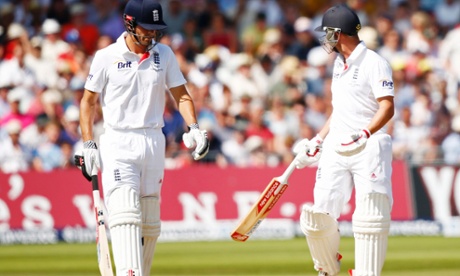
Alastair Cook - 7 Given the circus of hype surrounding the series and in particular the pressure of continuing Andrew Strauss' recent success in Ashes cricket, captain Cook could have been forgiven a nervous performance at Trent Bridge. Yet despite only scoring 13 in the first innings, he came back to score a vital half-century in the second and rescue his side from another early collapse.
As captain he continued his legacy as a calm and conservative operator despite having to manage his team through one of the most frenetic Test matches in recent years. He was also a dab hand with DRS.
Joe Root - 5 Undone by a peach in England's first innings and victim of a contentious decision in the second, Root was unlucky not to make a bigger contribution in his first outing as an England opener. He did however chip in with the ball, bagging Ed Cowan on the stroke of tea on day four to help spark a middle order collapse in the evening session.
Jonathan Trott - 6 Top scorer in England's first innings, he cruised to within two runs of a half-century only to throw his wicket away wafting loosely outside his offstump. He was, however, unlucky to be out LBW in his second outing, replays showing that the Warwickshire strokemaker got a healthy chunk of willow on the ball before it crashed into his pads.
www.guardian.co.uk
Kevin Pietersen - 6 A gritty 64 from 150 balls in the second innings made up for failure on the first morning and helped create something of a platform for Ian Bell. A gutsy knock in his first Test back after injury.
Ian Bell - 9 An important innings in so many ways, Bell's century proved to be one of the key differences between the two sides. Constructed in masterly fashion over days three and four, Bell took a conscious decision to avoid playing in the hallowed "V" and instead looked to nudge, nurdle and deflect the ball around the field, steadily accumulating runs and helping to nullify any Aussie pressure. Having already seen batsmen on both sides deceived by the slow and unpredictable nature of the surface, Bell's battle plan was little short of a masterstroke.
Jonny Bairstow - 6 Runs in both innings, he played the game at a good tempo and provided able support for Ian Bell on day three. His eagerness to play across the line of ball though continues to be his undoing.
Matt Prior - 6 Deservedly out for 0 first time out, he redeemed himself in part second time around with a useful counter-attacking display to help shift momentum England's way. Generally tidy behind the stumps he was also instrumental in England's effective use of the referral system.
Stuart Broad - 7 An impressive allround performance from Broad, he bowled with fire and accuracy to bag three vital Aussie scalps while also recording his highest Ashes score with the bat. A feisty and ultra-competitive performer, his decision not to walk in the second innings underlined the arrogance and self-belief that has helped him become a mainstay in England's ranks over the years.
Graeme Swann - 6 Four wickets in the match was not a bad return for England's jovial tweaker, but he never looked completely settled and struggled with his lengths in Australia's second innings. Steven Finn - 4 Two wickets in two balls on the first evening remained Finn's only highlight as he was carted around by the Aussie batsman in both innings. Replaced before in an Ashes series, he looks unlikely to feature at his home ground on Thursday. James Anderson - 10 A masterly display of conventional and reverse swing bowling, no one deserved the man of match award more than Anderson. Bowling almost 56 overs for figures of 10 for 158, he showed craft, control and endurance of the highest order to help keep his side in the contest throughout.
England 215
and 326 for 6 (Bell 95*, Broad 47*) lead Australia 280 by 261 runs
Ian Bell and Stuart Broad restored some calm to proceedings on day
three adding 108 runs for the seventh wicket to give the home side control at
the close of play.
Bell finished the day on 95, just five runs shy of what could be
one of his most important ever knocks for England. Often criticised for not
making "hard" runs, Bell read the match situation perfectly and
played an innings of the utmost maturity.
It was a fine example of risk management from the diminutive
Warwickshire strokemaker who took a conscious decision to avoid playing in the
hallowed "V" and instead looked to nudge, nurdle and deflect the ball
around the field, steadily accumulating runs and helping to nullify any Aussie pressure.
Having already seen batsmen on both sides deceived by the slow and
unpredictable nature of the surface, Bell's battle plan was little short of a
masterstroke.
Earlier in the day all eyes had been on Alastair Cook and Kevin
Pietersen. Resuming on 80 for 2 in blazing sunshine, they played out the first
hour watchfully, soon guiding England to three figures. Both batsman also notched up
half-centuries in the process and things were looking ominous for the
tourists halfway through the morning session. However, whilst the sun had given England fans hope of a run-heavy
day, the pitch was still not offering the pace and consistency that English
batsman traditionally crave.
Instead the Aussie bowlers took advantage of the turgid underfoot
conditions. Pietersen (64) played on after James Pattinson lured him into a
risky drive outside off, and captain Cook (50) followed soon after trying to push
Ashton Agar into the leg side only to close the face of the bat two early and
spoon a leading edge to Michael Clarke at first slip. England
precariously placed on 131 for 4, with a lead of just 67.
Ian Bell was promptly joined at the crease by Jonny Bairstow as they began to stage a mini-fightback in the afternoon session. The pair amassed 43 runs from 125 balls to help England back onto stable footing before Bairstow (15) was eventually undone by Agar, feathering one behind to Brad Haddin. Bell then shared an almost identically fruitful, yet brisker, partnership with Matt Prior (31). On this occasion it was 44 runs from 79 balls, but like before it was Bell's partner who was first to perish, the England keeper, looking to force the pace, miscuing a pull straight to midwicket.
Bell then joined Stuart Broad for what was to be the final stand of the day. First came glory as Bell reached fifty and in doing so also passed 6,000 runs in Test cricket, but then came controversy. With England sitting pretty on 297 for 6 Agar got Broad driving at a wide one which he dutifully edged to Clarke at slip. Umpire Aleem Dar though had failed to spot the deflection and Broad stood his ground. Crucially Australia had already wasted their reviews earlier in the day and, despite much protest, were forced to carry on their pursuit for yet another partnership penetrating delivery.
The Ashes summer is very nearly upon us, and with the first ball due in just a few hours, cricket buffs across the country are beginning to hypothesize about how the latest chapter in the game's oldest rivalry may pan out this year.
I've had a dig around and picked out five key things I think you should keep your eye on this summer.
Joe Root
Warmly welcomed into the England setup at the end of last year and already a favourite among the game's critics, Joe Root has fast become England's leading hot prospect.
A batsman with poise and patience well beyond his 22 years, Root exemplifies that which has made England's top order so successful in the inter-Ashes years. His debut knock of 73 from 229 balls no finer example of the composure that could see him quickly fill a Strauss-shaped void for years to come.
It is this composure too, I believe, that has seen him fast-tracked to the top of the pecking order for 10 July. Root has none of the blonde highlights and flashy off drives that made Ian Bell such a prospect in 2005. But I think interestingly it is the Yorkshireman's lack of/or ability to rein in his youthful flamboyance that has gained him favour with both cricket's inner and outer circles, and put him on the brink of an Ashes debut.
Spin Always a topic of conversation when England meet Australia, the Aussies have arrived with just one reputable spinner in the form of Nathan Lyon and young hopeful, Ashton Agar. Oh, and Steve Smith. Secret weapon Fahwad Ahmed could still play a role too. But whilst his ascent to potential Ashes selection is almost novel-worthy, he has only played 22 professional games and hardly set the world on fire in the process.
England have named Graeme Swann as their only frontline spinner and with the series likely to be decided in swing and seam-friendly conditions it would be hard to argue for the inclusion of another specialist tweaker.
Swann's record with the ball in Ashes cricket is, perhaps surprisingly, rather modest. Three wickets per game at an average of around 40 runs per wicket are not very Swann-like returns, but what Chin crucially offers that the Aussie spinners (I believe) do not, is the ability to hold up an end and to control a match. On more than one occasion he has proven an invaluable foil to England's trio of seamers, bowling marathon spells at economy rates well below the innings average.
In the fifth Test in 2009, after taking four wickets alongside Broad in the first innings, he then bowled 40 overs in the second and took a further four vital wickets at an economy of 2.97 (England's innings average was 3.4 runs per over). Another epic performance followed down under in 2010 when he churned out a 40 over spell in the second innings of the second Test, bagging five wickets in the process at an economy of 2.21, almost a run better than the team average.
The Return of KP An Ashes hero some eight years ago, but absent last time Australia toured England in 2009, Pietersen will be hungry to rekindle the kind of performance that saw him shoot to stardom in 2005.
His return will also bring some calm to England fans, many of which may have been fearing the potential fragility of England's batting lineup post Trott and pre-Prior, were he not fit.
He is of course an enigma, but he is more than likely to wade in with some important and no doubt entertaining runs at some point during the series. Averaging 52.71 in Ashes cricket, he is also likely to be the most talked about player in the Australian dressing room and could serve as a useful distraction for England's younger batsman as they try to establish themselves early on in the series.
The Captains Now this is fascinating. Neither Cook nor Clarke have taken charge of an Ashes Test, yet both have excelled under the "burden" of captaincy.
They have both been imperious over the past 12 months. Clarke averaging 84.14 in nine games, scoring four centuries in the process, with Cook averaging 52.10 in 12 games with six three-figure scores to his name. Clarke's stats though are a little skewed as the majority of his runs have come in Australia where he averages well over a hundred. Conversely Cook has scored more runs abroad (New Zealand and India) than he has at home.
In terms of Ashes calibre Clarke averages 45.50 and Cook 50.56. Each have four hundreds as well. Interestingly though, Clarke averages 48.93 against England in England, whereas Cook, who averages 65.12 against the Aussies in their backyard, only averages 24.66 against Australia in England, and has yet to score a century against them on home soil.
As captains they are still both establishing themselves, however they've each proven themselves to be more than useful in charge. In terms of style Clarke is more Warne-esque and quicker to think outside the box. Whereas Cook is very much in the mould of his predecessor and happy to sit back and remain patient.
Both world-class performers, this series and the return leg down under could well make a legedn of one of these men.
Aussie bowling attack If they steer clear of injury then Australia have a wealth of seam options. On paper all six of their plucky pacemen look to have tremendous potential, but for most that is still potential. Discounting Peter Siddle, the remaining five have just 33 Test caps between them, and James Faulkner has yet to even play a Test match. Add Ryan Harris and his injury woes into the equation and it could be a topsy-turvy series for Clarke's bowling unit.
Conditions will help though, and with England's batsman unlikely to have faced many of these young Aussie quicks, they could well have some success. However, over the course of five Test matches I think youth and inexperience may well begin show.
It will also be interesting to see how Michael Clarke manages his bowlers. In the 2010/11 series down under England made two series-defining changes to their bowling line-up midway through the tour. Tim Bresnan replaced the inconsistent Steven Finn and Chris Tremlett was given the nod as replacement for the injured Stuart Broad. Bresnan and Tremlett went on to take 20 wickets at 23 in England's victories in Melbourne and Sydney, helping England take control of the series. How Clarke manages this inevitable conundrum this summer may well be equally as pivotal.
In recent years it would be fair to say that amongst cricket's premier commentators any debate as to the future of Test cricket has been treated as something of a hot potato.
In an attempt to uncover the truth behind the future of the game, journalists and life-long cricket fans Sam Collins and Jarrod Kimber have travelled the cricketing world to ask the "heroes, villains, ogres and accountants" of the game whether (gulp) Test cricket really has a future in the new fast-paced and money-driven Twenty20 age.
And they've gone a made a film about it.
On their travels, Collins, former editor of thewisdencricketer.com, and Kimber, former editor of Spin Cricket Monthly Magazine and author of Australian Autopsy and When Freddie Met Jesus, track down a plethora of cricketing royalty in a quest to discover why the game has found itself at such an ugly crossroads.
Their hit list features some of the sport's most influential kingpins, including Lalit Modi, Ian Chappell, Giles Clarke, N Srinivasan and Michael Atherton, as well as a wealth of current and former players, such as former England captain Andrew Strauss, Kevin Pietersen and Rahul Dravid.
Collins and Kimber's film is largley punctuated by their encounters with friend and Aussie batsman Ed Cowan as he embarks on his debut Test series against India. The duo follow his journey through all four games and speak to him about what it means to play Test cricket in 2012. Running in parallel to what becomes an increasingly sinister excavation of the game's inner elite, Cowan's story questions whether an unashamed love for Test cricket can really outweigh the cynicism of an increasingly corporate sporting world, and provide a compelling case for the game’s survival.
However, as India's series goes from bad to worse and their fans chose to switch off, Collins and Kimber realise that the future of Test cricket, and the in fact whole fabric of the game, is already severely under threat.
The England selectors today announced a 16-man Test squad to be captained by Alastair Cook for the forthcoming four-match series in India.
The squad includes two uncapped batsmen, Somerset's Nick Compton and Yorkshire's Joe Root, and three spin bowlers: Samit Patel, Monty Panesar and Graeme Swann.
National Selector Geoff Miller said: "Nick Compton has performed well consistently for Somerset in county cricket this season, made big hundreds and shown that he has the temperament and the technique to play at a higher level.
Nick Compton
"Joe Root is a player who has been successful at every level from county cricket through to EPP and England Lions, and he deserves this opportunity to step up to the next level and press his case for a place in the Test side."
Kevin Pietersen, who was omitted from England's last Test match of the summer against South Africa, has not been included in the squad.
ECB Managing Director - England Cricket Hugh Morris added: "Both ECB and England team management have had meetings with Kevin Pietersen to address the issues which led to his omission from the final Investec Test match against South Africa.
"These discussions remain private and confidential and, as there are issues still to be resolved, Kevin has not been considered for selection for the India tour."
The selectors have also named a 17-strong England Performance Programme squad, which will undertake a month-long tour of India from mid-November, and a seven-man squad for next month's Hong Kong Sixes tournament, which will be captained by Leicestershire batsman Josh Cobb.
ECB Performance Director David Parsons said: "The England Performance Programme looks to identify and develop players that can go on to be world-class cricketers for England in the future.
"This year, following a brief period of training at the National Cricket Performance Centre, Loughborough, we have the opportunity to take players to the sub-continent to work on specific skills which will further their individual games.
"As in previous winters we will be shadowing the England team and their tour, which is a model we have successfully used since 2006, providing England with a group of players that can be called upon should the need arise.
"The England Lions squad for the tour to Australia in February 2013 will be selected towards the end of this training camp in December."
England Test squad to tour India
Alastair Cook (captain, Essex) James Anderson (Lancashire) Jonny Bairstow (Yorkshire) Ian Bell (Warwickshire) Tim Bresnan (Yorkshire) Stuart Broad (Nottinghamshire) Nick Compton (Somerset) Steven Finn (Middlesex) Graham Onions (Durham) Eoin Morgan (Middlesex) Monty Panesar (Sussex) Samit Patel (Nottinghamshire) Matt Prior (Sussex) Joe Root (Yorkshire) Graeme Swann (Nottinghamshire) Jonathan Trott (Warwickshire)
England Performance Programme squad to tour India
Jos Buttler (Somerset) Gary Ballance (Yorkshire) Scott Borthwick (Durham) Danny Briggs (Hampshire) Varun Chopra (Warwickshire) Matthew Coles (Kent) Jade Dernbach (Surrey) Ben Foakes (Essex) James Harris (Glamorgan) Simon Kerrigan (Lancashire) Craig Kieswetter (Somerset) Stuart Meaker (Surrey) Azeem Rafiq (Yorkshire) Toby Roland-Jones (Middlesex) Ben Stokes (Durham) James Taylor (Nottinghamshire) Chris Wright (Warwickshire)
England squad for Hong Kong Sixes
Tournament to be played at Kowloon Cricket Club on October 27 and 28
Josh Cobb (captain, Leicestershire) Adam Ball (Kent) Keith Barker (Warwickshire) Ben Brown (Sussex) Chris Nash (Sussex) Tom Smith (Lancashire) Ross Whiteley (Derbyshire)
Andy Hurry (manager, Somerset)
England Test squad - Tour itinerary
Oct 25: England squad leaves UK Oct 26-28: Training at ICC Global Cricket Academy in Dubai Oct 29: England squad arrives in India (Mumbai) Oct 30-Nov 1: Tour match (opponents TBC), Mumbai (CCI) (0400 GMT) Nov 3-5: Tour match (opponents TBC), Mumbai (BKC) (0400 GMT) Nov 8-11: Tour match (opponents TBC), Ahmedabad (SPS Navrangpura) (0400 GMT) Nov 15-19: First Test, Ahmedabad (Motera) (0400 GMT) Nov 23-27: Second Test, Mumbai (Wankhede Stadium) (0400 GMT) Dec 5-9: Third Test, Kolkata (0400 GMT) Dec 13-17: Fourth Test, Nagpur (0400 GMT)
As the third ICC World Twenty20 tournament kicks off this evening, I thought I'd post some highlights of England's historic win against Australia two years ago at the Kensington Oval in Barbados.
Kevin Pietersen and Craig Kieswetter led the way, tearing apart the Australian attack before Eoin Morgan and captain Paul Collingwood guided England comfortably over the line to secure victory and put an end to a 35 year wait for ICC silverware.
Over the past two decades cricket has been blessed with a handful of truly extraordinary performers. Yet it seems that as we enter the second decade of the new millennium that these once-in-a-generation superstars are now all but absent from our beloved game. Gone are Warne and McGrath, Ambrose and Walsh, Hayden and Langer and in their place a new breed of cricketer, the modern day allrounder.
Now don't be fooled. This new crop of talent are not, perhaps regretably, all budding Ian Bothams, Imran Khans, or, dare I say it, Andrew Flintoffs. They are not extroverts, nor sticklers for controversy, but rather normal, law-abiding professionals whose exploits tend to remain on the back rather than the front pages of the now presumably disinterested press. They are however slowly paving the way for a new era in international cricket, and one I'm happy to say is being led by the English.
So, what is this new 'all-rounder' I speak of? Well, in the absence of what Geoffrey Boycott would call truly 'great players', and with international cricket now played regularly across three different formats, cricketers are becoming increasingly aware of the need to diversify beyond the confines of their chosen specialty if they are to remain a permanent fixture in their team. This, as was evident with the Indian team this summer, is a mantra more readily embraced by some nations than others.
The hard truth is that unless you bowl at 95 mph, average over 50 runs per innings or turn the ball both ways then you can no longer rely on your primary trade, be it batting, bowling or wicketkeeping, to keep you in cricket's elite.
As the world's premier test nation, Ashes holders and World Twenty20 champions, England, it seems, have bought into this new philosophy of utility cricket more than most. Having watched with great interest, and at times a surprising amount of jubilation, England's ascent to the peak of the game ever since the disastrous series in the Caribbean in early 2009, I think it now time to reflect on why England's band of multi-talented cricketers have got this far.
Lead by example
If asked who more than most was responsible for England's rise to the top few would give Peter Moores any real consideration. Yet whilst his tenure as England coach may have been marred by scandal leading to his eventual dismissal in early 2009, he was to make one decision that would prove pivotal to England's subsequent success - Andy Flower.
Having employed Flower as batting coach at the national academy in 2005, Moores went on to appoint him his assistant when he took charge of the England team some two years later. While Moores' impact as a coach may have been generally uninspiring, his recognition of Flower's talents would be crucial to England's longevity as a top flight team. Taking over temporarily after Moores' departure, Flower eventually agreed to take the job full time, and despite a sticky start in the Caribbean England has never looked back since.
Alongside Andrew Strauss, Flower has taken an approach quite unique from that of his predecessors. With little support from cricket's 'old boys' he has set about creating a squad of professionals whose value is measured by their all-round performance rather than a player's reputation; a welcome departure from the narrow-mindedness that haunted England after the 2005 Ashes.
It is an approach that no doubt stems from his own experience as a cricketer. A world class wicket-keeper batsman and also national captain not too long ago, England's 'team director' knows full well the importance of cricketers who can contribute beyond their primary trade, and after nearly three years in charge his work is starting to pay off. England's bowlers now field better than almost entire sub-continental teams, Prior has elevated himself to perhaps the best wicket keeper batsman in the world (now Sanga has hung up his gloves) and England no longer have any genuine tail-enders. Flower has not only hand-picked a world-beating side but has developed an effective and lasting ethos that could see England at the top of the international game for many years to come.
Staying in shape
One of the marked changes to English cricket under Andy Flower has been to make cricketers into athletes. Over the years and largely thanks to exercise-resistant commentators like Sir Ian and Lord Gower, there has been an ongoing debate as to whether cricketers are perhaps over-trained. With new dietary regimes, team building weekends and even in-house psychologists many of cricket's stodgy elite have rubbished England's decidedly alcohol-free approach to match preparation. Once again though they couldn't be more wrong!
With the help of fitness fanatic Graham Gooch, Flower has created a team of lean and powerful cricketers whose physical prowess has been a deciding factor in recent times. Even Australia, whose penchant for fitness has been at the heart of their success for years, had to tip their hat to England this winter as they were made to toil in the heat for days on end as the likes of Cook and Trott pilled on the runs. Meanwhile the likes of Broad and Anderson had their feet up on the balcony fresh to rip through the Aussies as and when England decided they'd had enough.
Even against India this summer, who on paper looked a fine match for the home side, England's stamina and focus ultimately proved the deciding factor between the two teams. Indian players were sent home injured and England never took their foot off the pedal. Whilst fitness levels may only give a team an extra five per cent in a one day match (India's love-affair: IPL), over the course of Test series teams can find themselves quickly out of touch with their rivals if they are not physically prepared.
England though are cautious not to expect too much from their players, and whilst they firmly believe that players who contribute to all areas of the game are truly valuable commodities, they also understand that, especially considering English cricket's jam-packed schedule, it is not realistic to expect the same eleven players to perform at the same level all the time. As a result England management have introduced the strengthening and conditioning programme, giving players the opportunity to rest their bodies and to work on their core fitness for when they return to the team. Another example of staunch traditionalists eating their words the programme has been and continues to be a resounding success, and the resting of players like Steven Finn, James Anderson and Kevin Pietersen has helped England keep key players fresh and develop new and exciting prospects, especially in the longer form of the game.
Team Spirit
England more than most are a team who want to do things for each other. They enjoy one another's success and they work as a team. Whereas Andrew Flintoff tried to (and often did) do everything himself this current England team whilst brilliant individuals combine to create a truly all-round team motivated not just by their own performance but by the efforts of others.
Never does an England player in a post-match interview heap the praise on himself. Whilst it may be dull for those writing about the team, each and every player always takes time to congratulate the team effort and to express their delight that, despite having taken five wickets themselves, it is all the better only for the overall team performance. There is a sense of democracy about England at the moment. There is no great void between younger and older players, or one player propping up the team all the time, instead each player recognises that they can make a contribution and crucially that, however small, that contribution is valued.
To be an 'all-round team' a feeling of togetherness is essential, this means both on and off the field. Freddie's pedalo for example may have found England cricketers pushing the boat out a little too far in their spare time, but a few years later and Graeme Swann's Ashes diary seemed to have quite the opposite effect. Providing a hilarious but also encouraging insight into the England team's after hours shenanigans Swann's tapes revealed a team enjoying each other's company and a team spririt that has helped England team become the epitome of modern day all-rounders.
England XI - 8 for 223 dec. and 4 for 243 (Strauss 120*) beat Western Australia - 8 for 242 dec. and 223 (Swann 4-101, Broad 2-26) by six wickets
A tortuous beginning to the summer has left the Aussies with only a solitary victory so far in the build up to the Ashes later this month. Defeat by India in the Test and One Day series was swiftly followed by defeat to Sri Lanka in the only Twenty20 International and the first two One Day games of the three match series between the two sides, their only respite a dead-rubber win in the third ODI. Little consolation with Sri Lankan captain Kumar Sangakarra declaring his team's win as the finest in his tenure as captain.
Much to the dismay of Messrs Clarke and Ponting, England completed a convincing victory over Western Australia in their opening warm-up game, with captain Strauss on top form batting through England's second innings to cash in with 120 not out and see his side to victory in style.
England lost the toss and were asked to field first. With Jimmy Anderson the only surviving bowler from the last Ashes tour Down Under, it was up to the youthful pairing of Steven Finn and Stuart Broad to get to grips with the traditionally less forgiving Kookabura ball. In only the second over of the day however Broad, who has had a glorious summer with bat and ball, found himself on a hat-trick after dismissing opener Liam Davis and Michael Swart for a duck, both men guiding their shots into the safe hands of the English slip cordon.
Broad soon added another victim to his tally prising out captain Marcus North for 19 after some dogged resistance. Finn, Anderson and Graeme Swann all chipped in with a wicket a piece and the evergreen Paul Collingwood proving his continual importance to England's chances abroad, extracted the home side's two settled batsmen, catching Wes Robinson off his own bowling for 62 before running out the dangerous Adam Voges on 72.
Western Australia declared on 242 for 8 giving England a tricky six overs to bat before the close of play, and unfortunately for the visitors Alastair Cook fell victim to the late pressure when he was bowled off the midriff by Steve Magoffin for 5, with England due to resume on 10 for 1 in the morning.
Day two brought mixed fortunes for Strauss's men who struggled to take a firm hold on the game. After the loss of Cook the previous evening, the England top order failed to crack on and were undone by the seam and spin of the struggling domestic outfit. Magoffin bagging Strauss to claim the scalp of both the openers, before Trott was once again snuffed out by spin, caught behind off the bowling of Michael Beer.
Paul Collingwood and Matt Prior failed to make it to double figures and with Kevin Pietersen going well at the other end Ian Bell was also unable to give any sustained support departing for 21 from 42 balls. It was left to Broad to reclaim some dignity for the touring side and he ably accompanied Pietersen, both men passing fifty and taking England past 200. A late order cameo of 37 from 25 balls from Graeme Swann that included six boundaries ensured the hosts lead was only 19 at the halfway stage.
But useful contributions from Davies, Robinson and Swart meant that Western Australia closed on 109 for 1, 90 ahead of England with only a day left to play.
Day three brought about a renewed sense of purpose for England, and although a draw seamed the most likely result with just 90 overs in the day four wickets from Graeme Swann ably backed up by Finn and Broad saw the hosts lose their final nine wickets for a meager 93 runs and set up an intriguing fourth innings run chase.
The early loss again of Cook did not prove as disastrous this time around as Strauss provided the backbone to a enterprising display from England's top six. Three of the five bowlers used by captain North had economy rates above five and Jonathan Trott was the only England batsman to score his runs at a strike rate less than fifty, Bell and Pietersen scoring at more than a run a ball.
Strauss proved no slouch too, and his unbeaten 120 came from just 140 balls including 15 fours and a six, his hard work in the one day game recaptured magnificently into the longer format. England completed the chase within 50 overs claiming a six wicket victory and with it their first win of the tour, an enviable result for all Australians whose preparation for this year's Ashes has not begun quite so smoothly.
Despite a summer of low scores, Twitter rants and exile from both county and country, many still consider Kevin Pietersen the key if England are to retain the Ashes this winter.
Rewind back to May and Pietersen was enjoying what he described as the best week of his life, inspiring England to their first ever World Cup victory in the ICC World Twenty20 and witnessing the birth of his first son.
Since then little has gone the way of England’s talismanic number four who has not scored a hundred for England since March 2009, and who’s Test average is dipping perilously below 50.
Having been dropped justifiably from the one day series against Pakistan Pietersen joined up with new county Surrey in a bid to resurrect his form in time for the Ashes. No doubt an environmentally conscious decision from KP who parted company with Hampshire earlier in the year after observing that "geographically it just doesn't work – I live in Chelsea."
A hundred against Division Two outfit Sussex at Hove in the CB40 provided welcome time in the middle however a second-ball duck against Glamorgan in the County Championship ensured that questions still remained over his consistency at the highest level.
In a desperate attempt to regain form Pietersen agreed to travel to his home country of South Africa at the end of the season to play for KwaZulu-Natal Dolphins in two four-day matches.
A breezy 36 from 48 deliveries against the Warriors including six fours was largely overshadowed by a second-ball duck in his final game against the Titans, yet Pietersen remained upbeat about his progress abroad obviously rejuvenated by a return to his birthplace.
Questions still remain however, and as one of only seven survivors of England’s last series down under many have suggested that the 30-year-old does not deserve to simply stroll back into the dressing room as he has done for the last five years.
Critics will no doubt point to statistics, and rightly so, 2010 marks the first year in which Pietersen has failed to average above 40 in Test cricket passing 50 only once, not to mention an average of just 17.81 in 17 one day games since 2009.
It must not be forgotten also that England’s heroic triumph over the Aussies last year was orchestrated largely in his absence, an Achilles injury ruling him out of the final three Test matches, a factor that some attest to his dip in form over the past twelve months.
The decision to retain Pietersen for the Ashes therefore hinges almost entirely on reputation. England fans will still nurture fond memories of a young Pietersen charging down the wicket to the likes of Warne and McGrath in 2005, and if his performances in the World Twenty20 are anything to go by the fire still burns brightly within.
Much like his middle-order colleague Paul Collingwood Pietersen has made his reputation as a man for the big occasion, and they do not come much bigger than the historical battle between two of cricket’s most fiercely competitive nations for a small but highly sought after urn.
Whether he will once again unleash that fire still remains to be seen, but one thing that you can be sure of is that come November 25 there is one name that Ricky Ponting will be hoping is not scribbled on the team sheet and that is Kevin Peter Pietersen.
England 132 for 3 (Pietersen 42*) beat Sri Lanka 128 for 6 (Mathews 58, Broad 2-21) by seven wickets
In arguably their most commanding performance to date, England went about destroying the 2009 beaten finalists Sri Lanka in an almost perfect display from start to finish. Paul Collingwood lost the toss and was thrown the ball first up, a decision that did little to deter England who, bar a dogged half-century from Angelo Matthews, managed to restrict Sri Lanka to a less-than-competitive 128 for 6 from their 20 overs. In response England reached their target with four overs to spare courtesy of some powerful batting from the opening pair of Craig Kieswetter and Michael Lumb, who set the stage for Kevin Pietersen, having returned to the Caribbean following the birth of his first son, to top score with an unbeaten 42 from 26 balls. Sri Lanka's day did not start well as their decision to bat first on a tacky surface with moisture in the air proved a mistake. Ryan Sidebottom and Stuart Broad both struck with their first balls, Sri Lanka limping to 88 for 3 in the Powerplay. Sanath Jayasuriya edged a classic Sidebottom out-swinger to the England skipper at second slip, before Broad bagged the vital wicket of Mahela Jayawardene. The Sri Lankan opener proved only weeks ago that he is no mug with the bat in the shorter format of the game amassing a titanic amount of runs in the IPL opening the batting for the King's Punjab XI, and so Broad's clever cross-seam tempter that graced the edge of Jayawardene's bat was consequently a master-stroke of Twenty20 bowling.
At the finale of the Powerplay overs, and right on time, England's spin twins Yardy and Swann were called upon to stymie the run flow as the field opened up. Pressure soon told though with Yardy holding his lines expertly and Swann looking to take the attack to the opposition, and it was Kumar Sangakkara who eventually lost his patience with the Swann, drawn into playing at a beautifully looped delivery only to hole out to K.P at mid-off.
It was only Matthews that managed to not get bogged down by a highly-disciplined England bowling unit. He brought up his half-century from 41 balls, but even as he creamed 17 from Tim Bresnan's last over in rare episode of intent with the willow in hand, even he could not rescue Sri Lanka from slumping to a sub-standard 128 for 6.
The dangerous Mahela Jayawardene is sent back to the
dressing room after falling to Stuart Broad's first delivery of the day
Image courtesy of cricinfo.com
In an attempt to peg England back Sri Lanka opted to open with the spin of Tillakaratne Dilshan ans Ajantha Mendis, who duly obstructed the England openers to just six runs in two overs. But when Suraj Randiv was called upon, Kieswetter got stuck in with two trademark inside-out slogs over the covers from consecutive balls and the innings was on its way.
Michael Lumb joined Kieswetter in an opening stand of 68 in eight overs for the first wicket. having ridden their luck somewhat, the dynamic duo made the Sri Lankan spinners pay! Kieswetter clattering successive fours to bring up the end of the Powerplay overs, and the old left-arm of Jayasuriya was also met with some disdain, both men exchanging sixes in the spinner's first and last over.
With Kieswetter back in the shed thanks to a well directed yorker from Lasith Malinga, Lumb continued to chance his arm and should have joined his opening partner far sooner than he did were it not for some ill-discipline by the opposition fielders. In the end his 33 from 26 deliveries proved decisive in crushing Sri Lankan spirits and the result soon became inevitable.
With their heads on the floor the men in blue and yellow still had time to endure a timely onslaught from a jet-lagged Kevin Pietersen. But as Pietersen brushed off the talcum powder and donned the gloves it appeared that any off-field activities had only inspired him further, picking up where he left off against South Africa, he played with no-inhibitions whatsoever and remained unbeaten as his team crossed the line with time to spare.
England 168 for 7 (Pietersen 53, Botha 2-15) beat South Africa 129 (Duminy 39, Sidebottom 3-23) by 39 runs
England overcame their sternest test of the competition to date with a 39-run victory over South Africa in Barbados on Thursday thanks once again to an audacious half-century from Kevin Pietersen. Graeme Smith would have been confident of restricting England to a small total with the likes of Dale Steyn and Morne Morkel eager to run in on a pitch that promised both pace and bounce. Instead Smith completely misread conditions allowing England to post a formidable 168 for 7 with Paul Collingwood's versatile bowling line-up then able to use conditions to their advantage.
Over the past twelve months England have continued to frustrate South Africa in limited overs cricket. Success in the Proteas's back-garden at the end of 2009, and a win in the second warm-up match of the World Twenty20 has seen Smith's men unable to get a strangle hold on England, especially with Pietersen in the starting eleven! The South African-born stroke-maker has often saved his best for bouts with his home-country and today was no exception. A second wicket partnership of 94 with Craig Kieswetter highlighted Smith's miscalculation of conditions. Rarely has Dale Steyn been dispatched to all parts of the ground so readily in recent years. Between himself and fellow paceman Morkel they conceded a unprecedented 90 runs in their combined eight overs.
Surprisingly it was not Smith's choice to field a pace-heavy attack that came as his greatest misjudgement of the day. Prior to Pietersen and Kieswetter's match-winning partnership, Johan Botha had been chosen to open up for South Africa. As it turned out it was a master-stroke by Smith, Botha striking in his very first over trapping Michael Lumb plumb in front. Smith's downfall came though in his decision not to retain the spinner, and it was not until the twelfth over that Botha returned only to break the Pietersen-Kieswetter partnership ad leave the South African skipper a certain shade of red.
Charl Langeveldt saved further blushes with some outstanding death bowling, inspiring Morkel to recover his figures somewhat as England finished on 168 for 7, Botha bagging figures of 2 for 15 from his four overs.
South Africa's chase began far more circumspectly, Jacques Kallis and captain Smith choosing to gently rotate the strike rather than take advantage of the fielding restrictions. Tim Bresnan was allowed to get into his rhythm courtesy of the two openers lack of enterprise and soon struck, Kallis driving loosely to Pietersen at mid-off in the fifth over. South Africa's miserly continued when Michael Yardy was given the nod and dismissed Herschelle Gibbs with his first delivery. Crucially though Colly had learnt from Smith's mistake, and armed with two experienced spinners the duo went about unravelling South Africa's middle order. Graeme Swann joining forces with Yardy to take five wickets between them.
Jacques Kallis wears one as South Africa are
punished for a remarkably sedate start to their run-chase
Image courtesy of cricinfo.com
At 53 for 5 South Africa's task was likely to be too steep, but Ryan Sidebottom was not content to keep it tight, and following a sublime catch in the deep to remove the dangerous Gibbs he managed to pick up three wickets in his final two overs to bowl the Proteas out for 129 and complete an emphatic England victory. South Africa's one-dimensional approach with both bat and ball was an example of the versatility required to succeed in Twenty20 cricket - versatility luckily that England seem to have in abundance!
England 151 for 4 (Pietersen 73, Ajmal 2-18) beat Pakistan 147 for 9 (Butt 34, Yardy 2-19) by 6 wickets
With a frustrating group stage behind them, and more importantly not a rain-cloud in sight, normal service resumed chiefly thanks to Kevin Pietersen who clattered a 52-ball 72 not-out batting with the kind of authority and enterprise he is famed for.
England won the toss and having decided to bowl first were immediately forced onto the back-foot. Salman Butt and Mohammad Hafeez began brilliantly with the bat guiding Pakistan to 44 for 1 after the six Powerplay overs, and after England's spinners failed to make inroads it was the reigning champions who found themselves handily placed at 79 for 1 at the halfway stage. However momentum was short-lived as England's spinners swung the pendulum back in their favour with three key wickets in only eight deliveries, including Shahid Afridi who ran himself out for a first-call duck.
It became the turning point of the innings as The Green Machine went on to loose a further five wickets in the hope of posting a challenging total. The ever-promising Umar Akmal threatened with 30 from 25 balls before K.P took a brilliant catch only millimetres from the boundary edge to end his charge - a moment of inspiration that was to kick-start a triumphant day for Pietersen. Some shoddy work in the field from England meant Pakistan climbed from 120 for 7 to 147 for 9 in the final 2.4 overs, but it remained ultimately a disappointing total after an assured start, and Collingwood was no doubt the happier of the two captains at the break.
Chasing 148 to win Pakistan almost reigned England back in, and was it not for a plethora of schoolboy fielding it may it may have been a far nervier affair. Unfortunately it was Saeed Ajmal who bore much of the criticism, fumbling catches not once, not twice, but three times in the opening overs of England's innings. Twice he dropped Craig Kieswetter at mid-on and once Michael Lumb at mid-off. Salt was then shovelled into Ajmal's wounds as he watched the England openers boss their way to a stand of 44 in 5.4 overs. From there on in Pakistan struggled to find a cutting-edge, unable to put prolonged pressure on England's middle order.
Ajmal redeemed himself somewhat when he drew Lumb down the pitch to have him stumped on 25, and soon after Hafeez had Kieswetter caught for a less aggressive 25 by the more assured clasp of Umar Akmal. But crucially Afridi's boys failed to contain England's No. 3.
Having rode his luck early on it was a relief to all England fans to see Pietersen back to his relentless best. His timely assault on Afridi, Pakistan's failed aggressor, creaming two sixes on his way to a 37-ball half-century allowed the likes of Collingwood to work the ball into the gaps and watch from the non-striker's end as his towering team-mate made light work of a hapless all-round display in the field from their opponents.
A welcome return to form for Kevin Pietersen ensured
England's first victory of the tournament
Image courtesy of cricinfo.com
Pietersen remained unbeaten as England comfortably reached their target with the loss of only four wickets. Pakistan on the other hand may have been wondering what could have been after a late revival in their innings saw them post a total that was more-than-defendable. However a sloppy effort in the field cost them dearly and with England's most ferocious lion smelling blood Pakistan were always chasing the game.
Pakistan 149 for 6 (Razzaq 46*, Swann 3-14) beat England 148 for 6 (Pietersen 62) v Pakistan
What a difference 24 hours can make! After an ultimately one-sided affair in the first match Abdul Razzaq rolled back the years to produce a devastating cameo of six-hitting to square the series.
Pakistan again won the toss and put England in to bat. Paul Collingwood announced one change, the impressive Ryan Sidebottom forced to sit out due to a thigh strain, making way for Yorkshire pacemanAjmalShahzad, whilst the big news for Pakistan was the return of 'Boom Boom' Afridi, who still proves to be a menace both with bat, ball, and mouth of late.
There may have been a fresh look to both teams as the England openers strode out in Dubai, but young Joe Denly's career as a limited overs opening batsman seemed to continue in rather woeful fashion. Arafat getting one to nip back between bat and pad and clattering the stumps to give Pakistan a much deserved breakthrough. Jonathan Trott seemed equally hesitant at the crease managing only 3 fours in his 51-ball 39, fortunately Kevin Pietersen picked up where heleft off the day before, taking SaeedAjmal to the sword with a particularly brilliant straight drive down the wicket for six big ones.
Pietersen continued to look impervious, guiding two fours off Afridi, only to go bigger in his following over, ensuring that those in the high-rise hospitality suite were aware of his intentions. The tragedy of the innings ultimately came in his inability to really kick-on. And when attempting a sweep he was struck plumb on the back leg by Ajmal England really struggled to maintain the momentum KP had injected.
Eoin Morgan, Luke Wright and Collingwood amassed a six each but failed to make a sizable contribution, and crucially to form any sort of partnership. Tim Bresnan was even sent in for some last over pinch hitting, but when he hauled out to ImranNazir at long off first ball, you couldn't help but think that England had missed a chance to post something really challenging. Instead they stuttered to 148 for 6 when 160 plus looked attainable with five overs remaining.
Pakistan's victory in the second match meant the series was drawn 1-1 and the trophy shared
Image courtesy of cricinfo.com
Invigorated from their fightback with the ball, Pakistan returned to the field confident of knocking off the runs required, early signs however looked quite to the contrary as debutanteShahzad struck twice in his first over. First back in the changing room was Nazir, charging Shahzad third ball only to top edge to a grateful Bresnan at third man. Two balls later ImranFarhat had a rush of blood to the head attempting a pull off Shazhad only for the ball to be gobbled up by Stuart Broad at mid on.
At 4 for 2 Pakistan may have felt that they had missed a trick, unable to capitalise on their fine finish to England's innings. Luckily UmarAkmal showed maturity beyond his years playing a sensible innings manoeuvring the ball around and feeding off anything too short or wide. ShoaibMalik gave Akmal worthy assistance until he was undone by some sharp work from Matt Prior off the bowling of Graeme Swann, Malik's foot appearing to be marginally lifted as the bails were removed. Although if this was an indication to an improvement in Prior's glove-work he did his cause no good in Swann's next over seemingly dropping Akmal attempting a cut off a quicker ball.
Swann was not perturbed, and in his two final overs picked up the vital scalps of Afridi and the well set Akmal, finishing with stunning figures of 4 overs, 1 maiden, 3 for 14, truly a class act!
Swann's heroics were unfortunately a rare gem in some lacklustre performances from England's attack. Collingwood and Luke Wright the two part timers have a particularly hard time conceding 41 runs between them, failing to effectively stem the flow of runs. Such waywardness could almost be forgiven however, when considering that which stood imperiously at the other end.
With the hype around Afridi's return many had forgotten the cruel lessons Abdul Razzaq has taught bowlers over the years about bowling at the tail end an innings. After taking a viscous swipe at his first ball the 30 year old man from Lahore hit consecutive sixes off the England captain to set up a tight finish. Razzaq though was in no mood to hang around, and it was not long before Luke Wright saw the ball fly straight back over his head for Razzaq's third six of the innings.
Shahzad who had started so brightly was left with bitter memories of his first Twenty20 international, as Razzaq capped his magisterial innings with two thumping sixes to seal a 4 wicket win with an over to spare.
And with that final flail of the willow the series was over. All credit must go to Pakistan after they battled back admirably after a distinctly average first match. Razzaq was the star but Akmal played his part, and following the departure of Pietersen the Pakistani bowlers did well to keep the target within reach. Only time will tell how this brief contest will effect the progression of both these teams. For England, a resounding victory in the first match will give them great confidence in a form of the game they have yet to excel in. Equally Pakistan, although current holders of the Twenty20 World Cup, will be buoyed by their gutsy comeback in this match after looking dead and buried only a day ago.
England 130 for 3 (Morgan 67*, Pietersen 43*) beat Pakistan 129 for 8 (Malik 33) by seven wickets
England began their journey towards the Twenty20 World Cup in rather inauspicious circumstances at the Dubai International Cricket Stadium. Both teams came into the game following rather uninspiring build-ups, England who suffered a last ball defeat to the Lions courtesy of the ever-improving Craig Kieswetter, and Pakistan with only six players remaining from their triumphant Twenty20 World Cup campaign, hampered by the suspension of Shahid Afridi.
On a flat looking track Pakistan won the toss and elected to bat first. Unfortunately for Malik's men the pitch offered much more than initial omens suggested and Pakistan's top four faulted. After some tight, probing work from Ryan Sidebottom and Tim Bresnan, Imran Nazir finally hauled out to Joe Denly at deep square-leg after a trio of short pitched deliveries from a freshly shaven Stuart Broad. Some sharp work from the more rugged Kevin Pietersen had Imran Farhat ran out shortly after as Pakistan continued to struggle to score.
Luke Wright piled on the misery as the decidedly edgy Khalid Latif edged behind to Matt Prior for only 4. Following a disastrous series in Australia with the gloves Kamran Akmal was forced to watch his brother Umar from the sidelines. And after a brief flurry of boundaries it took a wonderful catch from Broad to dislodge him, Graeme Swann's fine form transferring effortlessly into the shorter format.
Despite their slowest ever start to a Twenty20 International Shoaib Malik and Fawad Alam put on 47 for the fifth wicket. Malik led from the front and began to rebuild, using his feet to Swann and smacking Wright for two consecutive fours. Swann returned for his second over only to produce another timely breakthrough, Malik departing for 33. Old hand replaced old hand as Abdul Razzaq maintained Pakistan's momentum, bludgeoning a Broad long hop for six. The Nottinghamshire paceman however soon found his length, Fawad undone by a well directed short ball managing to find the edge of the youngster's flailing willow.
England however regained full control as Pakistan struggled to set a competitive total. Sarfraz Ahmed's gorgeous slog-sweep was a rare moment of class amongst some decidedly average batting. Bresnan and Broad combining twice to prevent any real flourish in the final overs. Pakistan finally crept to 129 for 8, their batsmen never really able to stamp their authority on the game.
England's bowlers put in a great all-round performance to restrict Pakistan.
Image courtesy of cricinfo.com
Despite a below-par total, early breakthroughs by Abdul Razzaq and Yasir Arafat saw England slump to 18 for 3 in 4.2 overs, and for a brief moment the game was on again - but the moment was indeed very brief. Enter Kevin Pietersen and Eoin Morgan. Off the back of a disappointing series in South Africa, KP was looking to let his hair down, whilst Morgan, whose all round performances have shown signs of brilliance over the past year, was out to cement his place in the conveyor-belt that is the England one day side.
A nine-ball over from Malik helped Pietersen to settle into his stride, and from there on in it was very comfortable for England. Umar Gul, dubbed the most economical bowler in international "T20" failed to live up to his reputation and struggled to find a workable length - even his viscous yorkers deceiving him at the vital moments. England soon strolled home thanks to wonderful trio of boundaries from Morgan, finishing the chase with a crunching six ten rows back.
It was a night for Pakistan to forget - their bowlers failed to take advantage of a pitch that offered some variable bounce, and their batsmen lacked the composure and maturity to set up a decent score. England on the other hand will take a lot from this victory - in particular the return to form of Pietersen, who will undoubtedly will be pivotal to England's success in the Caribbean this Spring.