Pages

Showing posts with label Joe Root. Show all posts

Tuesday, July 16, 2013

1st Ashes Test: England player ratings

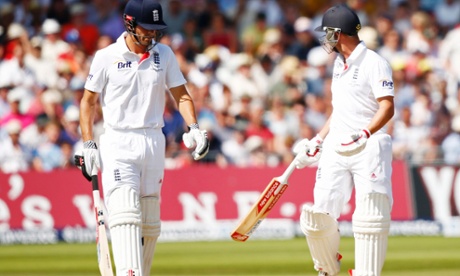
Alastair Cook - 7  Given the circus of hype surrounding the series and in particular the pressure of continuing Andrew Strauss' recent success in Ashes cricket, captain Cook could have been forgiven a nervous performance at Trent Bridge. Yet despite only scoring 13 in the first innings, he came back to score a vital half-century in the second and rescue his side from another early collapse.

As captain he continued his legacy as a calm and conservative operator despite having to manage his team through one of the most frenetic Test matches in recent years. He was also a dab hand with DRS.

Joe Root - 5  Undone by a peach in England's first innings and victim of a contentious decision in the second, Root was unlucky not to make a bigger contribution in his first outing as an England opener. He did however chip in with the ball, bagging Ed Cowan on the stroke of tea on day four to help spark a middle order collapse in the evening session.

Jonathan Trott - 6  Top scorer in England's first innings, he cruised to within two runs of a half-century only to throw his wicket away wafting loosely outside his offstump. He was, however, unlucky to be out LBW in his second outing, replays showing that the Warwickshire strokemaker got a healthy chunk of willow on the ball before it crashed into his pads.
www.guardian.co.uk

Kevin Pietersen - 6  A gritty 64 from 150 balls in the second innings made up for failure on the first morning and helped create something of a platform for Ian Bell. A gutsy knock in his first Test back after injury.

Ian Bell - 9  An important innings in so many ways, Bell's century proved to be one of the key differences between the two sides. Constructed in masterly fashion over days three and four, Bell took a conscious decision to avoid playing in the hallowed "V" and instead looked to nudge, nurdle and deflect the ball around the field, steadily accumulating runs and helping to nullify any Aussie pressure. Having already seen batsmen on both sides deceived by the slow and unpredictable nature of the surface, Bell's battle plan was little short of a masterstroke.

Jonny Bairstow - 6  Runs in both innings, he played the game at a good tempo and provided able support for Ian Bell on day three. His eagerness to play across the line of ball though continues to be his undoing.

Matt Prior - 6  Deservedly out for 0 first time out, he redeemed himself in part second time around with a useful counter-attacking display to help shift momentum England's way. Generally tidy behind the stumps he was also instrumental in England's effective use of the referral system.

Stuart Broad - 7  An impressive allround performance from Broad, he bowled with fire and accuracy to bag three vital Aussie scalps while also recording his highest Ashes score with the bat. A feisty and ultra-competitive performer, his decision not to walk in the second innings underlined the arrogance and self-belief that has helped him become a mainstay in England's ranks over the years.


Graeme Swann - 6   Four wickets in the match was not a bad return for England's jovial tweaker, but he never looked completely settled and struggled with his lengths in Australia's second innings.

Steven Finn - 4  Two wickets in two balls on the first evening remained Finn's only highlight as he was carted around by the Aussie batsman in both innings. Replaced before in an Ashes series, he looks unlikely to feature at his home ground on Thursday.

James Anderson - 10  A masterly display of conventional and reverse swing bowling, no one deserved the man of match award more than Anderson. Bowling almost 56 overs for figures of 10 for 158, he showed craft, control and endurance of the highest order to help keep his side in the contest throughout.

Wednesday, July 10, 2013

Ashes preview: Five things to look out for this summer

The Ashes summer is very nearly upon us, and with the first ball due in just a few hours, cricket buffs across the country are beginning to hypothesize about how the latest chapter in the game's oldest rivalry may pan out this year.

I've had a dig around and picked out five key things I think you should keep your eye on this summer.

Joe Root

Warmly welcomed into the England setup at the end of last year and already a favourite among the game's critics, Joe Root has fast become England's leading hot prospect.

A batsman with poise and patience well beyond his 22 years, Root exemplifies that which has made England's top order so successful in the inter-Ashes years. His debut knock of 73 from 229 balls no finer example of the composure that could see him quickly fill a Strauss-shaped void for years to come.

It is this composure too, I believe, that has seen him fast-tracked to the top of the pecking order for 10 July. Root has none of the blonde highlights and flashy off drives that made Ian Bell such a prospect in 2005. But I think interestingly it is the Yorkshireman's lack of/or ability to rein in his youthful flamboyance that has gained him favour with both cricket's inner and outer circles, and put him on the brink of an Ashes debut.

Spin

Always a topic of conversation when England meet Australia, the Aussies have arrived with just one reputable spinner in the form of Nathan Lyon and young hopeful, Ashton Agar. Oh, and Steve Smith. Secret weapon Fahwad Ahmed could still play a role too. But whilst his ascent to potential Ashes selection is almost novel-worthy, he has only played 22 professional games and hardly set the world on fire in the process.

England have named Graeme Swann as their only frontline spinner and with the series likely to be decided in swing and seam-friendly conditions it would be hard to argue for the inclusion of another specialist tweaker.

Swann's record with the ball in Ashes cricket is, perhaps surprisingly, rather modest. Three wickets per game at an average of around 40 runs per wicket are not very Swann-like returns, but what Chin crucially offers that the Aussie spinners (I believe) do not, is the ability to hold up an end and to control a match. On more than one occasion he has proven an invaluable foil to England's trio of seamers, bowling marathon spells at economy rates well below the innings average.

In the fifth Test in 2009, after taking four wickets alongside Broad in the first innings, he then bowled 40 overs in the second and took a further four vital wickets at an economy of 2.97 (England's innings average was 3.4 runs per over). Another epic performance followed down under in 2010 when he churned out a 40 over spell in the second innings of the second Test, bagging five wickets in the process at an economy of 2.21, almost a run better than the team average.

The Return of KP

An Ashes hero some eight years ago, but absent last time Australia toured England in 2009, Pietersen will be hungry to rekindle the kind of performance that saw him shoot to stardom in 2005.

His return will also bring some calm to England fans, many of which may have been fearing the potential fragility of England's batting lineup post Trott and pre-Prior, were he not fit.

He is of course an enigma, but he is more than likely to wade in with some important and no doubt entertaining runs at some point during the series. Averaging 52.71 in Ashes cricket, he is also likely to be the most talked about player in the Australian dressing room and could serve as a useful distraction for England's younger batsman as they try to establish themselves early on in the series.

The Captains

Now this is fascinating. Neither Cook nor Clarke have taken charge of an Ashes Test, yet both have excelled under the "burden" of captaincy.

They have both been imperious over the past 12 months. Clarke averaging 84.14 in nine games, scoring four centuries in the process, with Cook averaging 52.10 in 12 games with six three-figure scores to his name. Clarke's stats though are a little skewed as the majority of his runs have come in Australia where he averages well over a hundred. Conversely Cook has scored more runs abroad (New Zealand and India) than he has at home.

In terms of Ashes calibre Clarke averages 45.50 and Cook 50.56. Each have four hundreds as well. Interestingly though, Clarke averages 48.93 against England in England, whereas Cook, who averages 65.12 against the Aussies in their backyard, only averages 24.66 against Australia in England, and has yet to score a century against them on home soil.

As captains they are still both establishing themselves, however they've each proven themselves to be more than useful in charge. In terms of style Clarke is more Warne-esque and quicker to think outside the box. Whereas Cook is very much in the mould of his predecessor and happy to sit back and remain patient.

Both world-class performers, this series and the return leg down under could well make a legedn of one of these men.

Aussie bowling attack

If they steer clear of injury then Australia have a wealth of seam options. On paper all six of their plucky pacemen look to have tremendous potential, but for most that is still potential. Discounting Peter Siddle, the remaining five have just 33 Test caps between them, and James Faulkner has yet to even play a Test match. Add Ryan Harris and his injury woes into the equation and it could be a topsy-turvy series for Clarke's bowling unit.

Conditions will help though, and with England's batsman unlikely to have faced many of these young Aussie quicks, they could well have some success. However, over the course of five Test matches I think youth and inexperience may well begin show.

It will also be interesting to see how Michael Clarke manages his bowlers. In the 2010/11 series down under England made two series-defining changes to their bowling line-up midway through the tour. Tim Bresnan replaced the inconsistent Steven Finn and Chris Tremlett was given the nod as replacement for the injured Stuart Broad. Bresnan and Tremlett went on to take 20 wickets at 23 in England's victories in Melbourne and Sydney, helping England take control of the series. How Clarke manages this inevitable conundrum this summer may well be equally as pivotal.


Tuesday, September 18, 2012

Pietersen out, Compton and Root in for India Tour

The England selectors today announced a 16-man Test squad to be captained by Alastair Cook for the forthcoming four-match series in India.


The squad includes two uncapped batsmen, Somerset's Nick Compton and Yorkshire's Joe Root, and three spin bowlers: Samit Patel, Monty Panesar and Graeme Swann.
National Selector Geoff Miller said: "Nick Compton has performed well consistently for Somerset in county cricket this season, made big hundreds and shown that he has the temperament and the technique to play at a higher level.
                                                                          Nick Compton

"Joe Root is a player who has been successful at every level from county cricket through to EPP and England Lions, and he deserves this opportunity to step up to the next level and press his case for a place in the Test side."
Kevin Pietersen, who was omitted from England's last Test match of the summer against South Africa, has not been included in the squad.
ECB Managing Director - England Cricket Hugh Morris added: "Both ECB and England team management have had meetings with Kevin Pietersen to address the issues which led to his omission from the final Investec Test match against South Africa.
"These discussions remain private and confidential and, as there are issues still to be resolved, Kevin has not been considered for selection for the India tour."
The selectors have also named a 17-strong England Performance Programme squad, which will undertake a month-long tour of India from mid-November, and a seven-man squad for next month's Hong Kong Sixes tournament, which will be captained by Leicestershire batsman Josh Cobb.
ECB Performance Director David Parsons said: "The England Performance Programme looks to identify and develop players that can go on to be world-class cricketers for England in the future.
"This year, following a brief period of training at the National Cricket Performance Centre, Loughborough, we have the opportunity to take players to the sub-continent to work on specific skills which will further their individual games.
"As in previous winters we will be shadowing the England team and their tour, which is a model we have successfully used since 2006, providing England with a group of players that can be called upon should the need arise.
"The England Lions squad for the tour to Australia in February 2013 will be selected towards the end of this training camp in December."

England Test squad to tour India

Alastair Cook (captain, Essex)
James Anderson (Lancashire)
Jonny Bairstow (Yorkshire)
Ian Bell (Warwickshire)
Tim Bresnan (Yorkshire)
Stuart Broad (Nottinghamshire)
Nick Compton (Somerset)
Steven Finn (Middlesex)
Graham Onions (Durham)
Eoin Morgan (Middlesex)
Monty Panesar (Sussex)
Samit Patel (Nottinghamshire)
Matt Prior (Sussex)
Joe Root (Yorkshire)
Graeme Swann (Nottinghamshire)
Jonathan Trott (Warwickshire)

England Performance Programme squad to tour India

Jos Buttler (Somerset)
Gary Ballance (Yorkshire)
Scott Borthwick (Durham)
Danny Briggs (Hampshire)
Varun Chopra (Warwickshire)
Matthew Coles (Kent)
Jade Dernbach (Surrey)
Ben Foakes (Essex)
James Harris (Glamorgan)
Simon Kerrigan (Lancashire)
Craig Kieswetter (Somerset)
Stuart Meaker (Surrey)
Azeem Rafiq (Yorkshire)
Toby Roland-Jones (Middlesex)
Ben Stokes (Durham)
James Taylor (Nottinghamshire)
Chris Wright (Warwickshire)

England squad for Hong Kong Sixes

Tournament to be played at Kowloon Cricket Club on October 27 and 28
Josh Cobb (captain, Leicestershire)
Adam Ball (Kent)
Keith Barker (Warwickshire)
Ben Brown (Sussex)
Chris Nash (Sussex)
Tom Smith (Lancashire)
Ross Whiteley (Derbyshire)
Andy Hurry (manager, Somerset)

England Test squad - Tour itinerary

Oct 25: England squad leaves UK
Oct 26-28: Training at ICC Global Cricket Academy in Dubai
Oct 29: England squad arrives in India (Mumbai)
Oct 30-Nov 1: Tour match (opponents TBC), Mumbai (CCI) (0400 GMT)
Nov 3-5: Tour match (opponents TBC), Mumbai (BKC) (0400 GMT)
Nov 8-11: Tour match (opponents TBC), Ahmedabad (SPS Navrangpura) (0400 GMT)
Nov 15-19: First Test, Ahmedabad (Motera) (0400 GMT)
Nov 23-27: Second Test, Mumbai (Wankhede Stadium) (0400 GMT)
Dec 5-9: Third Test, Kolkata (0400 GMT)
Dec 13-17: Fourth Test, Nagpur (0400 GMT)

Tuesday, November 15, 2011

The Ultimate Breeding Ground: England's Young Hopefuls

Now the world’s premier Test playing nation and masters of Twenty20 cricket, England are for the first time in over two decades a happy and settled group of cricketers. A nucleus of selfless, hardworking individuals, they tower over all other popular sportsmen and women as definitive modern day professionals. Such an environment whilst highly prolific in the here and now though, also bodes well for the future of English cricket.

Nurturing up and coming talent has never been a simple task in English cricket. With no consistency in senior performances young players are not often giving the prolonged examination they deserve to prove their worth at international level. Australia’s dominance throughout the past fifteen years has allowed the likes of Michael Clarke and Ricky Ponting to develop into global superstars whilst England, under the watchful eye of the country’s more successful ancestors, only sought to find short term solutions to long term problems with young players never afforded the time required to adapt to the limelight.


Yet having toppled the all-conquering India on home soil this summer and with the Ashes having been in English hands for over two years, England now have a stable environment in which to cultivate their fresh-faced hopefuls into the next generation of international cricketers. With a core of experienced and reliable players alongside them, England’s youngsters are not likely to feel the kind of pressure they would have done were they born a decade and a half earlier, thus making the transition between county cricket and the international circuit even more achievable, and the chances of another generation of Graeme Hicks and Mark Ramprakash’s thankfully less and less likely. 

So, with this in mind here is a rundown of my prospective England XI and their chances of making themselves a part of English crickets potentially illustrious future:

Alex Hales
A statuesque opening batsman, Hales has been impressing for his county Nottinghamshire for over three years now. On a difficult Trent Bridge wicket Hales has excelled in all forms of the game. His performances in the shorter form of the game though have perhaps been his most impressive, top-scoring in the 2011 Friends Life t20 with 544 runs at 34 with a strike rate of 146 and earning himself a call up to the England Twenty20 squad in late August. A match-winning partnership with Craig Kieswetter against the West Indies in September in which he amassed an impressive 62 not out showed Hales to be a confident young man with a versatility that could see him become a regular in England’s set up in the near future.


Joe Root
A nuggety and determined opening bat, Joe Root is bred from hard Yorkshire stock. Having garnered praise from a notoriously pessimistic Geoffrey Boycott, Root has been touted for great things. Not yet 21 and having only played 18 first class games Root has already toured with England Lions and is set to do so again this winter. With Paul Collingwood no longer a Test match batsman and Jonathan Trott only now reaching the top of his game, Root may well present England’s best hope for another back-to-the-wall specialist. With flamboyancy an ever-increasing trait amongst young players Root’s back-to-basics approach could be an ideal foil to England’s band of youthful extroverts.

James Taylor
One of the most accomplished cricketers in county cricket it is no secret that England are hoping for big things from Taylor. With England’s top four so settled though the Leicestershire batsman will likely be given a few more years to consolidate his impressive start. Averaging just a shade under 50 runs per innings in both first class and one day cricket Taylor is a bona fide run-machine and unlike many England hopefuls may be one of only a few to begin his international career at Test level. The recipient of a Cricket Writer’s Young Player of the Year Award in 2009 Taylor has continued to build on his success ever since and you get the feeling it is just a matter of time before Andy Flower gives him the nod.

Ben Stokes
Signing a two year contract for Durham when he was only 18 Stokes was earmarked for big things from an early age. A powerful batsman and a talented bowler his ascent to the England ranks though has been marred by a long term finger injury hampering both his bowling and his fielding, something that was evident in his first few outings in international colours. A prolific season in 2011 has kept him firmly on Strauss and Flower’s radar and there is no doubt that his all-round abilities will be called upon again in the near future.


Jos Buttler
Amongst a plethora of young talent at Taunton Buttler has emerged as one of the most explosive cricketers in recent years. An improving first class record is somewhat dwarfed by his extraordinary displays in one day cricket. Even on a helpful track Buttler boasts a cool average of 71.16 in 40 over cricket despite having never passed three figures, a feat he’s managed whilst also keeping wicket for his hometown side. Named Young Wisden Schools Cricketer of the Year just a year ago and now on the cusp of a place in England’s limited overs setup, not to mention batting alongside the likes of Marcus Trescothick, Craig Kieswetter and James Hildreth at county level, Buttler has all the ingredients needed to become a prodigious international cricketer.

Jonny Bairstow
Another in a long line of young wicketkeeper-batsmen, Jonny Bairstow has been on fringes of the England team for over a year now. Picked up by the England Performance Squad at the back end of 2010, he went on to play a major part in the England Lions successful tour of the Caribbean this year and has since gone on to establish himself as Yorkshire’s number one gloveman. Despite being the son of former England wicketkeeper David Bairstow however, Bairstow junior has been touted as a potential specialist batsman. And with an average of 45 in 46 first class games and having knocked a breezy 41 off 21 balls on debut against India at Cardiff Bairstow looks set for England honours with or without his gloves.

To be continued…