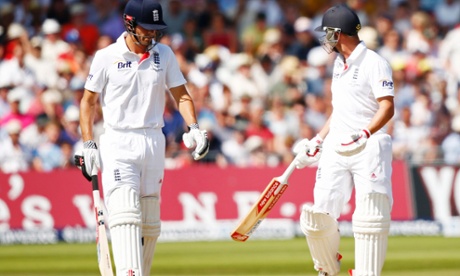
Alastair Cook - 7 Given the circus of hype surrounding the series and in particular the pressure of continuing Andrew Strauss' recent success in Ashes cricket, captain Cook could have been forgiven a nervous performance at Trent Bridge. Yet despite only scoring 13 in the first innings, he came back to score a vital half-century in the second and rescue his side from another early collapse.
As captain he continued his legacy as a calm and conservative operator despite having to manage his team through one of the most frenetic Test matches in recent years. He was also a dab hand with DRS.
Joe Root - 5 Undone by a peach in England's first innings and victim of a contentious decision in the second, Root was unlucky not to make a bigger contribution in his first outing as an England opener. He did however chip in with the ball, bagging Ed Cowan on the stroke of tea on day four to help spark a middle order collapse in the evening session.
Jonathan Trott - 6 Top scorer in England's first innings, he cruised to within two runs of a half-century only to throw his wicket away wafting loosely outside his offstump. He was, however, unlucky to be out LBW in his second outing, replays showing that the Warwickshire strokemaker got a healthy chunk of willow on the ball before it crashed into his pads.
www.guardian.co.uk
Kevin Pietersen - 6 A gritty 64 from 150 balls in the second innings made up for failure on the first morning and helped create something of a platform for Ian Bell. A gutsy knock in his first Test back after injury.
Ian Bell - 9 An important innings in so many ways, Bell's century proved to be one of the key differences between the two sides. Constructed in masterly fashion over days three and four, Bell took a conscious decision to avoid playing in the hallowed "V" and instead looked to nudge, nurdle and deflect the ball around the field, steadily accumulating runs and helping to nullify any Aussie pressure. Having already seen batsmen on both sides deceived by the slow and unpredictable nature of the surface, Bell's battle plan was little short of a masterstroke.
Jonny Bairstow - 6 Runs in both innings, he played the game at a good tempo and provided able support for Ian Bell on day three. His eagerness to play across the line of ball though continues to be his undoing.
Matt Prior - 6 Deservedly out for 0 first time out, he redeemed himself in part second time around with a useful counter-attacking display to help shift momentum England's way. Generally tidy behind the stumps he was also instrumental in England's effective use of the referral system.
Stuart Broad - 7 An impressive allround performance from Broad, he bowled with fire and accuracy to bag three vital Aussie scalps while also recording his highest Ashes score with the bat. A feisty and ultra-competitive performer, his decision not to walk in the second innings underlined the arrogance and self-belief that has helped him become a mainstay in England's ranks over the years.
Graeme Swann - 6 Four wickets in the match was not a bad return for England's jovial tweaker, but he never looked completely settled and struggled with his lengths in Australia's second innings. Steven Finn - 4 Two wickets in two balls on the first evening remained Finn's only highlight as he was carted around by the Aussie batsman in both innings. Replaced before in an Ashes series, he looks unlikely to feature at his home ground on Thursday. James Anderson - 10 A masterly display of conventional and reverse swing bowling, no one deserved the man of match award more than Anderson. Bowling almost 56 overs for figures of 10 for 158, he showed craft, control and endurance of the highest order to help keep his side in the contest throughout.
Australia 75 for 4 (Smith 38*, Hughes 7*) trail England 215 (Trott 48, Bairstow 37, Siddle 5-50, Pattinson 3-69) by 140 runs Steven Finn and James Anderson took two wickets each in the final session to spare the host's blushes after England were bowled out on the first day's play at Trent Bridge. Finn bagged Shane Watson and Ed Cowan in consecutive balls and James Anderson prised out the captain Michael Clarke and opener Chris Rogers to leave the visitors 75-4 at the close of play.
cricinfo.com The day began with the news that Australia had chosen to hand a debut to 19-year-old left arm spinner Ashton Agar. The Sri Lankan-born bowler replacing Nathan Lyon as Australia's only specialist spin option. There were no selection surprises in the England camp however with Joe Root given the nod at the top of the order and Finn retaining his place in the side ahead of Tim Bresnan.
There were no surprises too when Alastair Cook won the toss and chose to bat first on what looked like a slow, dry wicket. Clarke was not completely disheartened though as a cloudy Nottinghamshire skyline suggested his bowlers could have something to work with in the morning session. And, after a nervy few overs, he was right. James Pattinson made the first breakthrough luring Cook (13) into a woft outside his offstump before Peter Siddle mopped up Root (30) with an exquisite inswinging yorker. Trott though looked in fine touch, finding the boundary on numerous occasions in the opening hour-and-a-half, and, alongside Kevin Pietersen, was able to guide England to a respectable 98 for 2 at lunch. However, after lunch it was all Australia, or, more specifically, Peter Siddle. The Victorian's first victim Kevin Pietersen (14) playing a little too far outside his offstump and edging tamely to Clarke in the slips. Next came Trott (48), who, within sight of his half-century, briefly lost his composure to drag a wide Siddle delivery back onto his stumps. Ian Bell and Jonny Bairstow staged a mini fightback, but when Siddle returned for his second spell Bell (25) too fell pray to the fired up seamer. In his next over he made it five when Prior (1), trying to force the pace, attempted an expansive cut into the offside, only to find the grateful hands of Phil Hughes at point. England went in for tea tottering on 185 for 6.
www.cricinfo.com After tea things got little better for the hosts. Fleeting resistance from Stuart Broad came to an end when he top edged back to Pattinson for 24, and when Bairstow (37) and Finn (0) were dismissed in consecutive deliveries by a resurgent Mitchell Starc it was all but over for England. Ten balls later and it was. England all out for 215.
England fought back in the evening session to take four Australian wickets, but with brighter weather forecast for tomorrow Cook's men may well not be out the woods yet.
England have announced a sixteen man squad to take on Pakistan in the United Arab Emirates next month.
Stuart Broad, Eoin Morgan and Chris Tremlett have all recovered from injury and are included, whilst Monty Panesar is selected as second spinner. Ravi Bopara keeps his place after replacing the injured Jonathan Trott against India, and Steven Davies returns as Matt Prior's understudy. Tim Bresnan remains the only doubt having recently undergone elbow surgery.
Perhaps most surprising is the inclusion of Panesar who has not played for England since the first Test of the 2009 Ashes series. Since then Graeme Swann has gone on to establish himself as both England's and the world's premier offspin bowler, however with trips to Sri Lanka and India later in the year England are clearly keen to once again integrate Panesar into their plans. His chances of playing against Pakistan remain slim though with Andrew Strauss and Andy Flower likely to maintain the tried and tested six batsman, four bowlers ratio that worked so effectively this year.
Ravi Bopara will also likely find himself on the sidelines at least initially as England's batsman aim to continue what was a prolific year with the willow in hand. Having fought off competition from the likes of James Taylor and Johnny Bairstow, Bopara has done well to at least keep himself in the England setup, although he will have to make a marked improvement on his last outing in the subcontinent (Sri Lanka, 2007) if he is to remain in the picture in 2012.
With a cloud still hanging over Tim Bresnan, Steven Finn and Chris Tremlett will also be looking to stake their claim for a recall in the two three-day warm up matches before the first Test on January 16.
Over the past two decades cricket has been blessed with a handful of truly extraordinary performers. Yet it seems that as we enter the second decade of the new millennium that these once-in-a-generation superstars are now all but absent from our beloved game. Gone are Warne and McGrath, Ambrose and Walsh, Hayden and Langer and in their place a new breed of cricketer, the modern day allrounder.
Now don't be fooled. This new crop of talent are not, perhaps regretably, all budding Ian Bothams, Imran Khans, or, dare I say it, Andrew Flintoffs. They are not extroverts, nor sticklers for controversy, but rather normal, law-abiding professionals whose exploits tend to remain on the back rather than the front pages of the now presumably disinterested press. They are however slowly paving the way for a new era in international cricket, and one I'm happy to say is being led by the English.
So, what is this new 'all-rounder' I speak of? Well, in the absence of what Geoffrey Boycott would call truly 'great players', and with international cricket now played regularly across three different formats, cricketers are becoming increasingly aware of the need to diversify beyond the confines of their chosen specialty if they are to remain a permanent fixture in their team. This, as was evident with the Indian team this summer, is a mantra more readily embraced by some nations than others.
The hard truth is that unless you bowl at 95 mph, average over 50 runs per innings or turn the ball both ways then you can no longer rely on your primary trade, be it batting, bowling or wicketkeeping, to keep you in cricket's elite.
As the world's premier test nation, Ashes holders and World Twenty20 champions, England, it seems, have bought into this new philosophy of utility cricket more than most. Having watched with great interest, and at times a surprising amount of jubilation, England's ascent to the peak of the game ever since the disastrous series in the Caribbean in early 2009, I think it now time to reflect on why England's band of multi-talented cricketers have got this far.
Lead by example
If asked who more than most was responsible for England's rise to the top few would give Peter Moores any real consideration. Yet whilst his tenure as England coach may have been marred by scandal leading to his eventual dismissal in early 2009, he was to make one decision that would prove pivotal to England's subsequent success - Andy Flower.
Having employed Flower as batting coach at the national academy in 2005, Moores went on to appoint him his assistant when he took charge of the England team some two years later. While Moores' impact as a coach may have been generally uninspiring, his recognition of Flower's talents would be crucial to England's longevity as a top flight team. Taking over temporarily after Moores' departure, Flower eventually agreed to take the job full time, and despite a sticky start in the Caribbean England has never looked back since.
Alongside Andrew Strauss, Flower has taken an approach quite unique from that of his predecessors. With little support from cricket's 'old boys' he has set about creating a squad of professionals whose value is measured by their all-round performance rather than a player's reputation; a welcome departure from the narrow-mindedness that haunted England after the 2005 Ashes.
It is an approach that no doubt stems from his own experience as a cricketer. A world class wicket-keeper batsman and also national captain not too long ago, England's 'team director' knows full well the importance of cricketers who can contribute beyond their primary trade, and after nearly three years in charge his work is starting to pay off. England's bowlers now field better than almost entire sub-continental teams, Prior has elevated himself to perhaps the best wicket keeper batsman in the world (now Sanga has hung up his gloves) and England no longer have any genuine tail-enders. Flower has not only hand-picked a world-beating side but has developed an effective and lasting ethos that could see England at the top of the international game for many years to come.
Staying in shape
One of the marked changes to English cricket under Andy Flower has been to make cricketers into athletes. Over the years and largely thanks to exercise-resistant commentators like Sir Ian and Lord Gower, there has been an ongoing debate as to whether cricketers are perhaps over-trained. With new dietary regimes, team building weekends and even in-house psychologists many of cricket's stodgy elite have rubbished England's decidedly alcohol-free approach to match preparation. Once again though they couldn't be more wrong!
With the help of fitness fanatic Graham Gooch, Flower has created a team of lean and powerful cricketers whose physical prowess has been a deciding factor in recent times. Even Australia, whose penchant for fitness has been at the heart of their success for years, had to tip their hat to England this winter as they were made to toil in the heat for days on end as the likes of Cook and Trott pilled on the runs. Meanwhile the likes of Broad and Anderson had their feet up on the balcony fresh to rip through the Aussies as and when England decided they'd had enough.
Even against India this summer, who on paper looked a fine match for the home side, England's stamina and focus ultimately proved the deciding factor between the two teams. Indian players were sent home injured and England never took their foot off the pedal. Whilst fitness levels may only give a team an extra five per cent in a one day match (India's love-affair: IPL), over the course of Test series teams can find themselves quickly out of touch with their rivals if they are not physically prepared.
England though are cautious not to expect too much from their players, and whilst they firmly believe that players who contribute to all areas of the game are truly valuable commodities, they also understand that, especially considering English cricket's jam-packed schedule, it is not realistic to expect the same eleven players to perform at the same level all the time. As a result England management have introduced the strengthening and conditioning programme, giving players the opportunity to rest their bodies and to work on their core fitness for when they return to the team. Another example of staunch traditionalists eating their words the programme has been and continues to be a resounding success, and the resting of players like Steven Finn, James Anderson and Kevin Pietersen has helped England keep key players fresh and develop new and exciting prospects, especially in the longer form of the game.
Team Spirit
England more than most are a team who want to do things for each other. They enjoy one another's success and they work as a team. Whereas Andrew Flintoff tried to (and often did) do everything himself this current England team whilst brilliant individuals combine to create a truly all-round team motivated not just by their own performance but by the efforts of others.
Never does an England player in a post-match interview heap the praise on himself. Whilst it may be dull for those writing about the team, each and every player always takes time to congratulate the team effort and to express their delight that, despite having taken five wickets themselves, it is all the better only for the overall team performance. There is a sense of democracy about England at the moment. There is no great void between younger and older players, or one player propping up the team all the time, instead each player recognises that they can make a contribution and crucially that, however small, that contribution is valued.
To be an 'all-round team' a feeling of togetherness is essential, this means both on and off the field. Freddie's pedalo for example may have found England cricketers pushing the boat out a little too far in their spare time, but a few years later and Graeme Swann's Ashes diary seemed to have quite the opposite effect. Providing a hilarious but also encouraging insight into the England team's after hours shenanigans Swann's tapes revealed a team enjoying each other's company and a team spririt that has helped England team become the epitome of modern day all-rounders.
Steven Finn was named as the ICC's Emerging Player of the Year 2010 at the annual awards ceremony in Bengaluru, India after an impressive maiden year in Test cricket.
Having only made his debut in March of this year against Bangladesh, called up to replace the injured Graeme Onions, Finn has made a lasting impact on the England team this summer taking 32 wickets at an average of 23.21 including consecutive five wicket hauls at Lords and Old Trafford in May and June.
On the docile pitches of the sub-continent he showed a level of patience well beyond his years and was duly rewarded a first home cap in the return series against the Tigers two months later. Finn's impact was instantaneous, carrying the England bowling display in the first Test at Lords with figures of 4 for 100 in the first innings, going one better in the second innings leading the attack to claim his first five wicket haul, finishing the match with a tally of 9 wickets and a first Man of the Match award in Test cricket. His award was a testament to the hard work and determination shown by the young fast bowler sending down a titanic 49 overs all together in back to back innings.
In a less attritional affair at Old Trafford Finn proved equally affective. With Bangladesh following on once again it took a mere 10 overs for Finn to extract five Bangladeshi batsman and secure an innings victory for his team. His performances in the two match series earned him his first Man of the Series Award and was enough to put Finn as odds on favourite to board the plane to Australia come November.
A further flurry of wickets in the first two Test matches against Pakistan affirmed his place in the England eleven and consequently his nomination for the award.
Finn beat Australia's Tim Paine, Pakistan's Umar Akmal, and Sri Lanka's Angelo Matthews to the title that was awarded to Kevin Pietersen and Ian Bell in 2005 and 2006 respectively.
Graeme Swann and James Anderson were also included in the Test Team of the Year, and Paul Collingwood and Stuart Broad selected in the One Day Team of Year.
Swann, who was also nominated for the Player of the Year Award picked up by Sachin Tendulkar, played 10 Test matches within the period under consideration for the award, between August 24, 2009, and August 10, 2010, claiming 49 wickets at an average of 27.55. Anderson notching up 41 wickets in two less matches at 22.53.
Interestingly had the consideration period been more accommodating to the English season and accounted for the final two Test matches between England and Pakistan, Swann would have taken 16 more wickets at an improved average of 23.72. His figures against Pakistan reading four matches, 22 wickets at 12.22! Quite amazing when you also consider he was initially overlooked in the preliminary shortlist, only added when the ECB voiced there bewilderment at his absence!
A successful year for England's limited overs team that included series wins over Australia and away to South Africa could not be ignored and it was Stuart Broad and Paul Collingwood who broke into the One Day Team of the Year for 2010.
Broad, who has been ever present for England in all forms of cricket this year featured in 19 competitive one day matches taking 37 wickets at an average of 24.45, including 10 wickets in the 2009 ICC Champions Trophy.
Collingwood who again has been a regular feature in all England ventures this past year, racked up 24 matches in coloured clothes, averaging 47 with the bat and picking up 12 wickets. His performances on the tour of South Africa stood out in particular, hitting an unbeaten 105 at Centurion and averaging a colossal 91.66 in the four match series in which England triumphed 2-1, also claiming the Player of the Series Award after the final match was washed out.
England v Bangladesh, 1st Test at Lords, May 27 - 31, 2010.
England 505 (Trott 226, Hossain 5-98) & 163 for 2 beat Bangladesh 282 & 382 (Iqbal 103, Finn 5-87) by 8 wickets.
On the Front Foot
Jonathan Trott has had a topsy-turvy nine months since his Ashes heroics last Summer, but with his feet back on familiar shores Trott picked up where he started off with his maiden Test double ton and his second hundred in three innings in England. His 226 took England to an imposing 505 all out allowing Strauss to eventually enforce the follow on and lead his team to an eight wicket victory. Often criticised for his laborious manner at the crease Trott proved the glue to England's innings kick-starting his summer in the best way possible.
All Edge and No Middle
After a fine series as captain against the Tigers away from home Cook found little luck in the first Test. He was the only England batsman to be out for single figures in the first innings adjudged lbw off the bowling of Shahadat Hossain in the fifth over of the game. As it turned out Cook was unlucky to be back in the dressing room so early, hawkeye suggesting the ball would have gone over the stumps. Four days later and with England chasing 160 runs to win the Test match Cook was again trapped in front this time by Mahmadullah only for replays to reveal the ball would have flew over off and middle!
Line and Length
Five days and nine wickets later and Steven Finn is odds on to board the plane to Australia. A mechanical bowler with a conservative action Finn lets his bean pole stature and ice cool temperament do the talking. Unlike England apprentices before him who have reaped the rewards of overcast conditions or green top wickets Finn relied on persistence and skill for each of his nine wickets. In the first innings he bowled 25 overs for four of the top seven wickets prising out genuine edges once to Strauss at first slip, and twice to Prior, before clean bowling Rahim as Bangladesh refused to play to any stereotypes and needlessly give their wickets away.
With Bangladesh following on Finn was straight back into action charging in for another 24 overs in total this time getting himself on the Lords honours board claiming a much-deserved 5 for 87. After ending Tamim's onslaught Finn went about plying his trade with great skill. Whilst plugging away outside offstump Finn used subtle variation on a wearing pitch to keep the Tigers in check and completely outclass his fellow bowlers who amassed 86 overs and 274 runs collectively for the loss of the remaining five batsman.
Adrenaline Junkie
England's eight wicket victory whilst deserved was certainly not as easy an affair as they may have expected, and one man that will not be forgotten by the Lords crowds is Tamim Iqbal. His blistering 103 in 100 balls quickly prompted comparisons with Virender Sehwag and as the feisty left hander dispatched England's pace attack to all parts the likes of Broad and Bresnan may have been wishing they were bowling to the Indian opener.
Tamim's all-guns-blazing attitude to batting though is in reality a pragmatic approach to playing for Bangladesh, who one suspects will not get very far trying to grind out results, they're simply not in the same league as the world's best. Unfortunately while a blazing hundred in a one day game may be able to alone win the odd game, a moment of such brilliance in the context of a five day match will more often than not fail to sway the final result when your team mates lack your god-given talents.
England v Bangladesh, 2nd Test at Old Trafford, June 4-6, 2010.
England 419 (Bell 128, Al Hasan 5-121) beat Bangladesh 216 (Iqbal 108, Swann 5-76) & 123 (Finn 5-42) by an innings and 80 runs.
Anchor
At 153 for 4 the England innings could have gone one of two ways, Ian Bell made sure it went the way all home fans were hoping for. Batting for five and a half hours he absorbed early pressure and then went about bisecting the Bangladeshi fielders with the kind of maturity he has shown in the past 12 months. Ably assisted by Matt Prior (93) Bell took his side to 376 for 5 before he was unlucky to fall victim to a wonder delivery from Shakib Al-Hasan that gripped sharply off the surface making a mess of the batsman's stumps.
It was the temperament of 'The Sherminator's' knock that was most telling, the man who once only scored hundreds when in the company of other centurions and who had been heavily criticised for getting out when well set was now leading his team into a winning position. If his marathon innings against South Africa was an indication of his new found maturity this was confirmation of his continual importance in the England middle order.
Unlikely Hero
While Bell and Prior were piling on the misery for his team Shakib Al Hasan the Bangladesh captain took it on himself to try and inspire a breakthrough. A thoughtful bowler Shakib has already taken six five wicket hauls in Test cricket at a healthy average of just over 30. It so happened that his hard work payed off and he was rewarded with the wicket of Ian Bell albeit against the run of play. The ball darted in to leg stump bell pushed at it expecting to be able to guide the ball into the leg side, instead the ball gripped and spun viciously to miss Bell's bat flick the off bail.
That bit of magic proved decisive as 376 for 6 became 419 all out, the captain causing the majority of the damage and picking up a hard earned five-for, his final figures reading 37.3 overs, 5 for 121 with three maidens.
Lone Ranger
Another lost cause, another outstanding innings, Tamim Iqbal's refreshing attitude to batting and abislity to rack up substantial scores from ball one has elavated the 21 year old to cult status as of late and his second century in as many matches has simply put the cherry on the cake.
108 from 114 balls was the equation this time around, exactly half of the Bangladesh total score. It wasn't enough to save his team but that was never the point Tamim is not selfish or unruly as many may presume he is a realist and his inspirational approach to batting is a lesson to all.
The Turning Point
The most improved cricketer in world cricket, it rarely comes as a surprise nowadays when Swanny bags a five-for, and that was exactly what he did after Anderson had the dangerous Tamim caught behind. Siddique was too easy for Swann his impatience his undoing eventually succumbing to Swann's immaculate line and length and edging to Prior. Islam was next to go, lured into wafting outside his offstump only to mistime his drive and gift Swann a classic offspinner's dismissal gripping and turning and crashing into the middle stump.
The rest was childsplay for a man of Chin's quality and as his fingers rolled over what was to be the final cherry of the Test Hossain was trapped on the crease and swiftly adjudged lbw by the crooked finger of Billy Bowden, game, set, match!