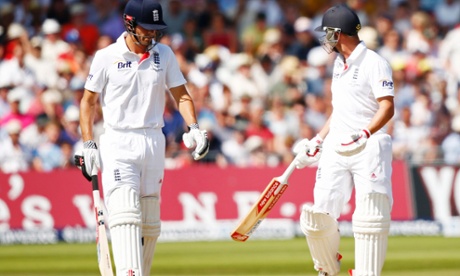
England 289 for 7 (Bell 109, Bairstow 67, Smith 3-18) v Australia
Three quick wickets from part-time legspinner Steve Smith in the evening session ensured Australia held the initiative going into day two of the second Ashes Test at Lords.
Smith took 3 for 12 in 22 balls in an unexpectedly potent spell of legbreak bowling. First Ian Bell was undone by some prodigious spin out of the rough, caught at slip, then Jonny Bairstow gifted Smith his second knocking a full bunger back to the bowler. Smith completed the rout deceiving Matt Prior with a variation ball out of the front of hand.
England won the toss and chose to bat on what looked like an ideal day for run scoring. News from the toss was that Steven Finn would miss out on his home ground and that Tim Bresnan, who so ably replaced Finn in the last series, would get a birth. The Aussies made two changes. Usman Khawaja in for Ed Cowan and the talented Ryan Harris in for Mitchell Starc.
Despite losing the toss it was the Australians who delivered the early blows in a hectic first hour. After James Pattinson’s first two overs were dispatched for 12, Michael Clarke made an inspired early change, bringing Shane Watson into the attack. Two balls into his spell and the allrounder bagged the key wicket of the England captain, Alastair Cook undone by a full
swinging delivery trapping him plump in front for just 12.
With one came two as Ryan Harris got into the action in the next over. His victim the ever-popular Joe Root. Full and straight and crashing into the pads, Root (6) too was caught on the crease. And, after an unsuccessful review, was back in the hutch with his captain.
And two the became three when Kevin Pietersen (2), always vulnerable early in his innings, edged behind to Haddin off Harris. Six overs in, three wickets down and just 28 on the board and England were in need of a characterful performance from their middle order, and they did not disappoint.
First Ian Bell and Jonathan Trott steadied the ship either side of lunch. Both men taking full advantage of the batsman-friendly conditions and finding the boundary rope at regular intervals. Trott soon passed fifty and looked set for a bucket load but gave his wicket away shortly after lunch. Harris, again the
man on the money, banged one in just short of a length and Trott (58) took the bait lamely pulling into the legside and sending a top edge flying to Khawaja at deep square.
However, unlike before, England were able to prevent another mini-collapse and Bell set about rebuilding with his new partner Jonny Bairstow. The latter though was lucky to survive the session when in the 50th over he was cleaned bowled by Peter Siddle for just 21. The Yorkshire allrounder was given a second life though when the umpires called upstairs to check on a potential no ball. Replays showing that Siddle had just failed to land any part of his foot behind the line.
After tea Bell and Bairstow carried on where they had left off. First Bairstow passed fifty in a confidence boosting innings
for the young number 6, and then Bell reached three figures. It was Bell's second century in as many innings and, like at Trent Bridge, it was a ton that altered the balance of the game, at least temporarily.
Alastair Cook - 7 Given the circus of hype surrounding the series and in particular the pressure of continuing Andrew Strauss' recent success in Ashes cricket, captain Cook could have been forgiven a nervous performance at Trent Bridge. Yet despite only scoring 13 in the first innings, he came back to score a vital half-century in the second and rescue his side from another early collapse.
As captain he continued his legacy as a calm and conservative operator despite having to manage his team through one of the most frenetic Test matches in recent years. He was also a dab hand with DRS.
Joe Root - 5 Undone by a peach in England's first innings and victim of a contentious decision in the second, Root was unlucky not to make a bigger contribution in his first outing as an England opener. He did however chip in with the ball, bagging Ed Cowan on the stroke of tea on day four to help spark a middle order collapse in the evening session.
Jonathan Trott - 6 Top scorer in England's first innings, he cruised to within two runs of a half-century only to throw his wicket away wafting loosely outside his offstump. He was, however, unlucky to be out LBW in his second outing, replays showing that the Warwickshire strokemaker got a healthy chunk of willow on the ball before it crashed into his pads.
www.guardian.co.uk
Kevin Pietersen - 6 A gritty 64 from 150 balls in the second innings made up for failure on the first morning and helped create something of a platform for Ian Bell. A gutsy knock in his first Test back after injury.
Ian Bell - 9 An important innings in so many ways, Bell's century proved to be one of the key differences between the two sides. Constructed in masterly fashion over days three and four, Bell took a conscious decision to avoid playing in the hallowed "V" and instead looked to nudge, nurdle and deflect the ball around the field, steadily accumulating runs and helping to nullify any Aussie pressure. Having already seen batsmen on both sides deceived by the slow and unpredictable nature of the surface, Bell's battle plan was little short of a masterstroke.
Jonny Bairstow - 6 Runs in both innings, he played the game at a good tempo and provided able support for Ian Bell on day three. His eagerness to play across the line of ball though continues to be his undoing.
Matt Prior - 6 Deservedly out for 0 first time out, he redeemed himself in part second time around with a useful counter-attacking display to help shift momentum England's way. Generally tidy behind the stumps he was also instrumental in England's effective use of the referral system.
Stuart Broad - 7 An impressive allround performance from Broad, he bowled with fire and accuracy to bag three vital Aussie scalps while also recording his highest Ashes score with the bat. A feisty and ultra-competitive performer, his decision not to walk in the second innings underlined the arrogance and self-belief that has helped him become a mainstay in England's ranks over the years.
Graeme Swann - 6 Four wickets in the match was not a bad return for England's jovial tweaker, but he never looked completely settled and struggled with his lengths in Australia's second innings. Steven Finn - 4 Two wickets in two balls on the first evening remained Finn's only highlight as he was carted around by the Aussie batsman in both innings. Replaced before in an Ashes series, he looks unlikely to feature at his home ground on Thursday. James Anderson - 10 A masterly display of conventional and reverse swing bowling, no one deserved the man of match award more than Anderson. Bowling almost 56 overs for figures of 10 for 158, he showed craft, control and endurance of the highest order to help keep his side in the contest throughout.
England 215 and 80 for 2 (Cook 37*, Pietersen 35*) lead Australia 280 (Agar 98, Hughes 81*, Anderson 5-85) by 15 runs 19-year-old débutante Ashton Agar was the star of day two as he and Phil Hughes put on a world record tenth wicket partnership to keep the first Ashes Test firmly in the balance. Agar joined Hughes at the crease with the score 117 for 9 and went on to share a 163-run partnership that saw Australia surpass England's total and give the tourists a first innings lead of 65. The Aussie teenager was eventually dismissed two runs shy of a debut hundred, spooning a short pitched ball to a grateful Graeme Swann in the deep. The damage had been done though and the entire Trent Bridge crowd rose to their feet in recognition of a truly remarkable innings.
www.cricinfo.com The day's early exchanges though had all belonged to England. On what looked like an ideal day for batting, Steve Smith (53) threw away the chance to build on his good work the night before when he drove loosely at Anderson and edged to Matt Prior. Another followed shortly after when Swann found some prodigious turn to bowl Brad Haddin (1) just two balls into his knock. Seven balls later and Anderson bagged his second of the morning courtesy of Peter Siddle's (1) outside edge and Prior's exceptional dexterity. Two overs later and Mitchell Starc (0) also succumbed to Anderson's spell, feathering an angled delivery through to the England wicketkeeper to give the Burnley Express a richly deserved five wicket haul. Swann then made it nine down trapping James Pattinson plumb in front for two. But Agar had other ideas, and with the help of Hughes was able to carve out an exquisite Test match innings worthy of any top order batsman. Solid in defence and clinical in attack, Agar hit 11 fours and two sixes on his way to a 101-ball 98, eclipsing Tino Best's 95 against England at Edgbaston last summer to record the highest ever score by a number 11 batsman. Taking inspiration from their new team mate's extraordinary innings, the Australian bowlers then went about consolidating their favourable position in 7.3 overs before tea. Joe Root was first to go, edging Starc down the legside for 5, and the very next ball Jonathan Trott was on his way after the Aussies successfully overturned an LBW shout. Controversy followed shortly after as it emerged that the third umpire had overruled Aleem Dar's decision despite not being able to view Hotspot from the crucial side-on angle as the technology had been cued to show Root's dismissal down the leg side. Slow motion replays indicated that Trott may well have hit the ball before it rapped his pads. The ECB has since requested clarification from the ICC about the decision.
www.cricinfo.com As the day began to come to a close Alastair Cook and Kevin Pietersen restored some sanity to proceedings grinding out the remaining overs to leave England 80 for 2 at the close, 15 runs ahead.
England and Warwickshire batsman Jonathan Trott has been ruled out of the remainder of the domestic season with an undisplaced fracture of the third metacarpal in his right hand.
The injury was sustained during the fourth one-day international in the current NatWest Series against South Africa and, although initial X-rays were clear, a subsequent MRI scan revealed a fracture at the base of his third metacarpal.
Jonathan Trott
No intervention is required and the 31-year-old should be able to resume batting in three to four weeks and is expected to available for the tour of India next month.
Trott will miss Warwickshire's CB40 Final against Hampshire at Lords on 15 September, but is expected to be available for England's Test tour of India at the end of October.
Over the past two decades cricket has been blessed with a handful of truly extraordinary performers. Yet it seems that as we enter the second decade of the new millennium that these once-in-a-generation superstars are now all but absent from our beloved game. Gone are Warne and McGrath, Ambrose and Walsh, Hayden and Langer and in their place a new breed of cricketer, the modern day allrounder.
Now don't be fooled. This new crop of talent are not, perhaps regretably, all budding Ian Bothams, Imran Khans, or, dare I say it, Andrew Flintoffs. They are not extroverts, nor sticklers for controversy, but rather normal, law-abiding professionals whose exploits tend to remain on the back rather than the front pages of the now presumably disinterested press. They are however slowly paving the way for a new era in international cricket, and one I'm happy to say is being led by the English.
So, what is this new 'all-rounder' I speak of? Well, in the absence of what Geoffrey Boycott would call truly 'great players', and with international cricket now played regularly across three different formats, cricketers are becoming increasingly aware of the need to diversify beyond the confines of their chosen specialty if they are to remain a permanent fixture in their team. This, as was evident with the Indian team this summer, is a mantra more readily embraced by some nations than others.
The hard truth is that unless you bowl at 95 mph, average over 50 runs per innings or turn the ball both ways then you can no longer rely on your primary trade, be it batting, bowling or wicketkeeping, to keep you in cricket's elite.
As the world's premier test nation, Ashes holders and World Twenty20 champions, England, it seems, have bought into this new philosophy of utility cricket more than most. Having watched with great interest, and at times a surprising amount of jubilation, England's ascent to the peak of the game ever since the disastrous series in the Caribbean in early 2009, I think it now time to reflect on why England's band of multi-talented cricketers have got this far.
Lead by example
If asked who more than most was responsible for England's rise to the top few would give Peter Moores any real consideration. Yet whilst his tenure as England coach may have been marred by scandal leading to his eventual dismissal in early 2009, he was to make one decision that would prove pivotal to England's subsequent success - Andy Flower.
Having employed Flower as batting coach at the national academy in 2005, Moores went on to appoint him his assistant when he took charge of the England team some two years later. While Moores' impact as a coach may have been generally uninspiring, his recognition of Flower's talents would be crucial to England's longevity as a top flight team. Taking over temporarily after Moores' departure, Flower eventually agreed to take the job full time, and despite a sticky start in the Caribbean England has never looked back since.
Alongside Andrew Strauss, Flower has taken an approach quite unique from that of his predecessors. With little support from cricket's 'old boys' he has set about creating a squad of professionals whose value is measured by their all-round performance rather than a player's reputation; a welcome departure from the narrow-mindedness that haunted England after the 2005 Ashes.
It is an approach that no doubt stems from his own experience as a cricketer. A world class wicket-keeper batsman and also national captain not too long ago, England's 'team director' knows full well the importance of cricketers who can contribute beyond their primary trade, and after nearly three years in charge his work is starting to pay off. England's bowlers now field better than almost entire sub-continental teams, Prior has elevated himself to perhaps the best wicket keeper batsman in the world (now Sanga has hung up his gloves) and England no longer have any genuine tail-enders. Flower has not only hand-picked a world-beating side but has developed an effective and lasting ethos that could see England at the top of the international game for many years to come.
Staying in shape
One of the marked changes to English cricket under Andy Flower has been to make cricketers into athletes. Over the years and largely thanks to exercise-resistant commentators like Sir Ian and Lord Gower, there has been an ongoing debate as to whether cricketers are perhaps over-trained. With new dietary regimes, team building weekends and even in-house psychologists many of cricket's stodgy elite have rubbished England's decidedly alcohol-free approach to match preparation. Once again though they couldn't be more wrong!
With the help of fitness fanatic Graham Gooch, Flower has created a team of lean and powerful cricketers whose physical prowess has been a deciding factor in recent times. Even Australia, whose penchant for fitness has been at the heart of their success for years, had to tip their hat to England this winter as they were made to toil in the heat for days on end as the likes of Cook and Trott pilled on the runs. Meanwhile the likes of Broad and Anderson had their feet up on the balcony fresh to rip through the Aussies as and when England decided they'd had enough.
Even against India this summer, who on paper looked a fine match for the home side, England's stamina and focus ultimately proved the deciding factor between the two teams. Indian players were sent home injured and England never took their foot off the pedal. Whilst fitness levels may only give a team an extra five per cent in a one day match (India's love-affair: IPL), over the course of Test series teams can find themselves quickly out of touch with their rivals if they are not physically prepared.
England though are cautious not to expect too much from their players, and whilst they firmly believe that players who contribute to all areas of the game are truly valuable commodities, they also understand that, especially considering English cricket's jam-packed schedule, it is not realistic to expect the same eleven players to perform at the same level all the time. As a result England management have introduced the strengthening and conditioning programme, giving players the opportunity to rest their bodies and to work on their core fitness for when they return to the team. Another example of staunch traditionalists eating their words the programme has been and continues to be a resounding success, and the resting of players like Steven Finn, James Anderson and Kevin Pietersen has helped England keep key players fresh and develop new and exciting prospects, especially in the longer form of the game.
Team Spirit
England more than most are a team who want to do things for each other. They enjoy one another's success and they work as a team. Whereas Andrew Flintoff tried to (and often did) do everything himself this current England team whilst brilliant individuals combine to create a truly all-round team motivated not just by their own performance but by the efforts of others.
Never does an England player in a post-match interview heap the praise on himself. Whilst it may be dull for those writing about the team, each and every player always takes time to congratulate the team effort and to express their delight that, despite having taken five wickets themselves, it is all the better only for the overall team performance. There is a sense of democracy about England at the moment. There is no great void between younger and older players, or one player propping up the team all the time, instead each player recognises that they can make a contribution and crucially that, however small, that contribution is valued.
To be an 'all-round team' a feeling of togetherness is essential, this means both on and off the field. Freddie's pedalo for example may have found England cricketers pushing the boat out a little too far in their spare time, but a few years later and Graeme Swann's Ashes diary seemed to have quite the opposite effect. Providing a hilarious but also encouraging insight into the England team's after hours shenanigans Swann's tapes revealed a team enjoying each other's company and a team spririt that has helped England team become the epitome of modern day all-rounders.
England v Bangladesh 1st ODI, Natwest Series, at Trent Bridge July 8 2010.
England 251 for 4 (Bell 84, Strauss 50) beat Bangladesh 250 for 9 (Siddique 51, Al Hasan 76) by 6 wickets.
A Comedy of Errors
If all Bangladesh could muster in the Test arena were brief moments of brilliance or an inspired session here and there, the more forgiving and fast-paced nature of the one day game it was possible would prove a more fruitful format. Early signs were promising for the Tigers, all top six batsmen reaching double figures including two half centuries from Junaid Siddique and Raqibul Hassan. But it was the former who fell crucially short of a big score, run out for 76 with three overs remaining. Raqibul guiding the ball to midwicket for an easy single, only for Faisal Hossain, Raqibul's runner, to be caught ball watching. Shakib set off from the non-striker's end but was surprised when he saw Faisal motionless, in confusion Shakib desperately ran back for his own crease while Faisal stutteres halfway down the track. The ball was sent in to Kieswetter, Raqibul grounding his own bat but to no avail as Faisal was nowhere to be seen, a comedy of errors that prevented the tourists posting a more challenging total on a good batting deck at Trent Bridge.
The Tortoise and the Hare
In reply England began positively, Kieswetter building on his impressive summer so far with a useful knock of 32 from 40, but it was his the England captain that was most adventurous crashing 50 off just 37 deliveries. The manner in which Strauss went about his business was a sure sign that he refuses to be typecast as a one-paced, methodical opening batsman only suited to Test cricket. It appears his assuredness in defence actually heightens the impact of his aggression, pouncing on anything marginally off-line Strauss never descends to recklessness but instead punishes the opposition for ill-discipline in spectacular fashion.
However, moments after raising his bat for his half century the England skipper was run out by Mahmadullah. Kieswetter dabbing one into the covers, Strauss calling for the single but tragically underestimating the accuracy of the throw not diving to make sure of the run and caught napping inches short of the crease. In the absence of Kevin Pietersen and Jonathan Trott, it was up to Ian Bell to negate the middle overs in the crucial number three position.
Joining Paul Collingwood initially, the pair manipulated the field expertly keeping the board ticking over at a healthy rate, Collingwood eventually succumbed to the left arm spin of Shakib Al Hasan making way for Eoin Morgan. Bell maintained a steady pace rotating the strike admirably in order to allow Morgan to flay the bat more willfully, the Irishman chipping in with a swift 23 from 26 deliveries including two fours and a six. It was left to Bell and Yardy to finish off the job with just under five overs remaining. The experience showed by Bell, who remained unbeaten on 84 underlined the entire England chase, a professional display from a confident group of cricketers who have yet to lose a series (or World cup competition) this year.
England v Bangladesh 2nd ODI, Natwest Series, at The County Ground July 10 2010.
Bangladesh 236 for 7 (Kayes 76, Shahzad 3-41) beat England 231 (Trott 94) by 5 runs.
Team Spirit
At the halfway stage there was a sense of deja vu about proceedings, Bangladesh having posted a below-par total were set the task of restricting, or most likely bowling out England if they were to claim victory. There was certainly no room for a patchy bowling effort and you felt that to win the game Bangladesh would require a high class team effort.
Rubel Hossain led by example claiming the scalps of openers Strauss and Kieswetter in consecutive overs to leave the home side 58 for 2 after nine overs. Collingwood survived the bowling Powerplay and was unlucky to be dismissed soon after by Abdur Razzak who was fortunate to see the finger raised for an appeal lbw. Seven balls later and England's middle order hero of late Eoin Morgan was sent back again by Razzaq for just one run. This time England had no complaints, the ball going on to hit the top of middle stump.
Yardy continued his nervy England career with a woeful 10 from 24 balls to take England over the hundred mark, Shakib outfoxing the Sussex allrounder, luring him into the pull shot only for the ball to slide under Yardy's bat and clatter into his offstump. Meanwhile Jonathan Trott went about his business providing much needed solidity to England's flailing run chase, his fifty coming off 91 deliveries, and as Luke Wright departed with over 15 overs remaining it was Trott who really held the key to what would now be a surprise defeat for England.
The bowlers provided little resistance, Stuart Broad providing some brief entertainment, his 21 featuring a four and a six. Ian Bell did return to the field despite a suspected broken foot, but with three balls to go and six runs remaining it was Trott, who required the same amount of runs for his century, who was last to go, the two Islams combining to force an edge from Trott's bat and complete a famous victory for Bangladesh. A wonderful effort and one that ensured the series would go down to a crucial decider at Edgbaston.
England v Bangladesh 3rd ODI, Natwest Series, at Edgbaston July 12 2010.
England 347 for 7 (Strauss 154, Trott 110, Mortaza 3-31) beat Bangladesh 203 (Bopara 4-38) by 144 runs.
Record Breakers
So one a piece and all to play for, and following a dramatic victory two days previous Bangladesh were on the brink of their first series win against England in history. As it turned out it was the hosts who entered the record books that afternoon, the immovable forces of Andrew Strauss and Jonathan Trott milking the Tigers for all they had notching up a second wicket partnership of 250, the highest ever in England's one day history, surpassing Strauss and Flintoff's 226 run partnership recorded against the West Indies at Lords in 2004. A nervy start soon became an enterprising double act lifting England from 1 for 1 to 251 for 2 four balls into the final ten overs of the innings Strauss and Trott playing against the grain of their stereotype.
Trott was powerful and precise in his shot selection and remained focused throughout while Bangladeshi heads slowly dropped unable to find a breakthrough for a whole 240 balls. It took a joint effort between captain and former captain to prise Trott from the wicket, the Warwickshire stalwart creaming a full delivery to midwicket where Shakib took an athletic catch, but not before Trott had notched up his first ever one day international century, and another under-pressure knock when his team was in need of inspiration.
At the other end Strauss compiled an innings he has been threatening to produce all summer. Having been run out in farcical circumstances two days ago the England captain was determined to cash in on this occasion creaming the Bangladesh bowlers to all parts for his remarkable 154. A strike rate of 110 underlined the brutality of Strauss's knock which included five rare sixes, his eighth of the summer, having only scored a further ten since his debut in 2003.
England v Bangladesh, 1st Test at Lords, May 27 - 31, 2010.
England 505 (Trott 226, Hossain 5-98) & 163 for 2 beat Bangladesh 282 & 382 (Iqbal 103, Finn 5-87) by 8 wickets.
On the Front Foot
Jonathan Trott has had a topsy-turvy nine months since his Ashes heroics last Summer, but with his feet back on familiar shores Trott picked up where he started off with his maiden Test double ton and his second hundred in three innings in England. His 226 took England to an imposing 505 all out allowing Strauss to eventually enforce the follow on and lead his team to an eight wicket victory. Often criticised for his laborious manner at the crease Trott proved the glue to England's innings kick-starting his summer in the best way possible.
All Edge and No Middle
After a fine series as captain against the Tigers away from home Cook found little luck in the first Test. He was the only England batsman to be out for single figures in the first innings adjudged lbw off the bowling of Shahadat Hossain in the fifth over of the game. As it turned out Cook was unlucky to be back in the dressing room so early, hawkeye suggesting the ball would have gone over the stumps. Four days later and with England chasing 160 runs to win the Test match Cook was again trapped in front this time by Mahmadullah only for replays to reveal the ball would have flew over off and middle!
Line and Length
Five days and nine wickets later and Steven Finn is odds on to board the plane to Australia. A mechanical bowler with a conservative action Finn lets his bean pole stature and ice cool temperament do the talking. Unlike England apprentices before him who have reaped the rewards of overcast conditions or green top wickets Finn relied on persistence and skill for each of his nine wickets. In the first innings he bowled 25 overs for four of the top seven wickets prising out genuine edges once to Strauss at first slip, and twice to Prior, before clean bowling Rahim as Bangladesh refused to play to any stereotypes and needlessly give their wickets away.
With Bangladesh following on Finn was straight back into action charging in for another 24 overs in total this time getting himself on the Lords honours board claiming a much-deserved 5 for 87. After ending Tamim's onslaught Finn went about plying his trade with great skill. Whilst plugging away outside offstump Finn used subtle variation on a wearing pitch to keep the Tigers in check and completely outclass his fellow bowlers who amassed 86 overs and 274 runs collectively for the loss of the remaining five batsman.
Adrenaline Junkie
England's eight wicket victory whilst deserved was certainly not as easy an affair as they may have expected, and one man that will not be forgotten by the Lords crowds is Tamim Iqbal. His blistering 103 in 100 balls quickly prompted comparisons with Virender Sehwag and as the feisty left hander dispatched England's pace attack to all parts the likes of Broad and Bresnan may have been wishing they were bowling to the Indian opener.
Tamim's all-guns-blazing attitude to batting though is in reality a pragmatic approach to playing for Bangladesh, who one suspects will not get very far trying to grind out results, they're simply not in the same league as the world's best. Unfortunately while a blazing hundred in a one day game may be able to alone win the odd game, a moment of such brilliance in the context of a five day match will more often than not fail to sway the final result when your team mates lack your god-given talents.
England v Bangladesh, 2nd Test at Old Trafford, June 4-6, 2010.
England 419 (Bell 128, Al Hasan 5-121) beat Bangladesh 216 (Iqbal 108, Swann 5-76) & 123 (Finn 5-42) by an innings and 80 runs.
Anchor
At 153 for 4 the England innings could have gone one of two ways, Ian Bell made sure it went the way all home fans were hoping for. Batting for five and a half hours he absorbed early pressure and then went about bisecting the Bangladeshi fielders with the kind of maturity he has shown in the past 12 months. Ably assisted by Matt Prior (93) Bell took his side to 376 for 5 before he was unlucky to fall victim to a wonder delivery from Shakib Al-Hasan that gripped sharply off the surface making a mess of the batsman's stumps.
It was the temperament of 'The Sherminator's' knock that was most telling, the man who once only scored hundreds when in the company of other centurions and who had been heavily criticised for getting out when well set was now leading his team into a winning position. If his marathon innings against South Africa was an indication of his new found maturity this was confirmation of his continual importance in the England middle order.
Unlikely Hero
While Bell and Prior were piling on the misery for his team Shakib Al Hasan the Bangladesh captain took it on himself to try and inspire a breakthrough. A thoughtful bowler Shakib has already taken six five wicket hauls in Test cricket at a healthy average of just over 30. It so happened that his hard work payed off and he was rewarded with the wicket of Ian Bell albeit against the run of play. The ball darted in to leg stump bell pushed at it expecting to be able to guide the ball into the leg side, instead the ball gripped and spun viciously to miss Bell's bat flick the off bail.
That bit of magic proved decisive as 376 for 6 became 419 all out, the captain causing the majority of the damage and picking up a hard earned five-for, his final figures reading 37.3 overs, 5 for 121 with three maidens.
Lone Ranger
Another lost cause, another outstanding innings, Tamim Iqbal's refreshing attitude to batting and abislity to rack up substantial scores from ball one has elavated the 21 year old to cult status as of late and his second century in as many matches has simply put the cherry on the cake.
108 from 114 balls was the equation this time around, exactly half of the Bangladesh total score. It wasn't enough to save his team but that was never the point Tamim is not selfish or unruly as many may presume he is a realist and his inspirational approach to batting is a lesson to all.
The Turning Point
The most improved cricketer in world cricket, it rarely comes as a surprise nowadays when Swanny bags a five-for, and that was exactly what he did after Anderson had the dangerous Tamim caught behind. Siddique was too easy for Swann his impatience his undoing eventually succumbing to Swann's immaculate line and length and edging to Prior. Islam was next to go, lured into wafting outside his offstump only to mistime his drive and gift Swann a classic offspinner's dismissal gripping and turning and crashing into the middle stump.
The rest was childsplay for a man of Chin's quality and as his fingers rolled over what was to be the final cherry of the Test Hossain was trapped on the crease and swiftly adjudged lbw by the crooked finger of Billy Bowden, game, set, match!