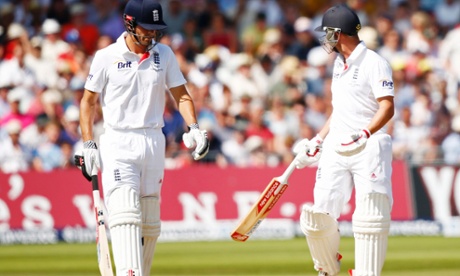
Alastair Cook - 7 Given the circus of hype surrounding the series and in particular the pressure of continuing Andrew Strauss' recent success in Ashes cricket, captain Cook could have been forgiven a nervous performance at Trent Bridge. Yet despite only scoring 13 in the first innings, he came back to score a vital half-century in the second and rescue his side from another early collapse.
As captain he continued his legacy as a calm and conservative operator despite having to manage his team through one of the most frenetic Test matches in recent years. He was also a dab hand with DRS.
Joe Root - 5 Undone by a peach in England's first innings and victim of a contentious decision in the second, Root was unlucky not to make a bigger contribution in his first outing as an England opener. He did however chip in with the ball, bagging Ed Cowan on the stroke of tea on day four to help spark a middle order collapse in the evening session.
Jonathan Trott - 6 Top scorer in England's first innings, he cruised to within two runs of a half-century only to throw his wicket away wafting loosely outside his offstump. He was, however, unlucky to be out LBW in his second outing, replays showing that the Warwickshire strokemaker got a healthy chunk of willow on the ball before it crashed into his pads.
www.guardian.co.uk
Kevin Pietersen - 6 A gritty 64 from 150 balls in the second innings made up for failure on the first morning and helped create something of a platform for Ian Bell. A gutsy knock in his first Test back after injury.
Ian Bell - 9 An important innings in so many ways, Bell's century proved to be one of the key differences between the two sides. Constructed in masterly fashion over days three and four, Bell took a conscious decision to avoid playing in the hallowed "V" and instead looked to nudge, nurdle and deflect the ball around the field, steadily accumulating runs and helping to nullify any Aussie pressure. Having already seen batsmen on both sides deceived by the slow and unpredictable nature of the surface, Bell's battle plan was little short of a masterstroke.
Jonny Bairstow - 6 Runs in both innings, he played the game at a good tempo and provided able support for Ian Bell on day three. His eagerness to play across the line of ball though continues to be his undoing.
Matt Prior - 6 Deservedly out for 0 first time out, he redeemed himself in part second time around with a useful counter-attacking display to help shift momentum England's way. Generally tidy behind the stumps he was also instrumental in England's effective use of the referral system.
Stuart Broad - 7 An impressive allround performance from Broad, he bowled with fire and accuracy to bag three vital Aussie scalps while also recording his highest Ashes score with the bat. A feisty and ultra-competitive performer, his decision not to walk in the second innings underlined the arrogance and self-belief that has helped him become a mainstay in England's ranks over the years.
Graeme Swann - 6 Four wickets in the match was not a bad return for England's jovial tweaker, but he never looked completely settled and struggled with his lengths in Australia's second innings. Steven Finn - 4 Two wickets in two balls on the first evening remained Finn's only highlight as he was carted around by the Aussie batsman in both innings. Replaced before in an Ashes series, he looks unlikely to feature at his home ground on Thursday. James Anderson - 10 A masterly display of conventional and reverse swing bowling, no one deserved the man of match award more than Anderson. Bowling almost 56 overs for figures of 10 for 158, he showed craft, control and endurance of the highest order to help keep his side in the contest throughout.
It has been an intriguing twelve months for Test cricket. Amid fears for the health and longevity of the game’s premier format, 2011 churned up some of the most exciting and hotly contested cricket in recent years. England destroyed almost everyone in their path on the way to becoming world number one, Australia and South Africa shared the spoils in perhaps the greatest two match series ever, Sri Lanka won their first Test in South Africa, and India and the West Indies helped record only the second ever scores level draw in the history of Test match cricket. And that really is just the beginning.
In and amongst such drama though was of course plenty of individual brilliance and with the 2012 now finally underway it seems only appropriate to indulge my inner schoolboy and compile my ultimate Test XI for 2011.
Are you in agreement?
Alastair Cook 927 runs at 84.27. Without a doubt the stand out batsman of 2011, Alastair Cook has gone from strength to strength since his extraordinary end to 2010. He began the year by adding a magnificent 189 in the final Ashes Test in Sydney to take his series total to a mammoth 766 runs before notching up a further 390 runs in three Tests against Sri Lanka including two centuries and a 96. If that was not enough, Cook rounded off his landmark year by crafting a career best 296 against India as he helped England ascend to number one in the world.
Rahul Dravid 1145 runs at 57.25. One of only two batsmen to score over 1000 runs in 2011 Dravid succeeded where many of his Indian colleagues failed. A match-winning century against the West Indies in Jamaica in June was only to be outdone by three back-to-the-wall hundreds in England as he proved himself to be a class above the rest of India’s old boys.
Hashim Amla 423 runs at 47.00. A curious choice perhaps with the likes of Jacques Kallis and Sachin Tendulkar not included despite boasting more prolific records, but Amla’s performances, especially against Australia, earn him a deserved place. A 195 run partnership with captain Graeme Smith in the first Test in Cape Town proved his calmness under pressure after both teams had been dismissed for less than 100 runs in previous innings, and despite losing the second Test in Johannesburg Amla’s five and a half hour 105 in the second innings ensured that the match went down to the wire. A man for the big occasion no doubt.
Kumar Sangakkara 1034 runs at 49.23. The number one Test match batsman according to the ICC Test rankings and the second most prolific run-getter in 2011 Kumar Sangakkara continued to demonstrate his class against the world’s best. Sri Lanka plied their trade against stiff opposition in 2011, travelling to England and South Africa as well hosting Australia and playing Pakistan in the UAE. However, despite only one Test victory all year Sangakkara emerged as imperious as ever bagging three hundreds and a double ton to help his team remain competitive throughout.
Ian Bell 950 runs at 118.75. Rid of his boyish insecurities Ian Bell has flourished into a Test match batsman of unrivalled class. Always stylish but not always prolific, Bell’s hunger for runs has made him into a seriously effective cricketer. A maiden Ashes hundred at Sydney was followed by two unbeaten centuries against Sri Lanka, before a gorgeous 159 against world champions India at Trent Bridge. His defining innings though came in the final Test of the summer. Batting at number three in place of the injured Jonathan Trott, Bell scored a magisterial 235 to help England complete another innings victory and seal a 4-0 series whitewash. Sheer class!
Darren Bravo 949 runs at 49.94. Lofty comparisons with cousin Brian Lara are perhaps a little premature, but there is no doubting that if the West Indies are to return as a genuine force in world cricket then the continued success of Darren Bravo is paramount. Having to wait nine Test matches before recording his first century Bravo eventually reached three figures in style bagging a greedy 195 against Bangladesh this October. Two further centuries quickly followed against India, his total haul of 214 in Mumbai proving pivotal in a famous score draw.
Matt Prior 519 runs at 64.87, 34 catches, two stumpings. It has been a career-defining couple of years for Matt Prior who, provided Sangakkara doesn’t decide to re-don the gloves, now stands as arguably the world’s best keeper-batsman. Batting at number seven, Prior’s selfless attitude to batting and willingness to marshal an admittedly very capable tail has made him an indispensable part of the England set up. A century in all three of England’s Test series in 2011 only represents a fraction of his contribution.
Stuart Broad 33 wickets at 22.30, 239 runs at 39.83. Having missed most of England’s tour of Australia through injury and with the emergence of Tim Bresnan and Chris Tremlett as his replacements during that victorious Ashes campaign there was at least a smidgen of pressure on Stuart Broad to hit his straps in 2011, and that he did. In four Tests against India Broad averaged over 60 with the bat as well as taking mammoth 25 wickets at an average of just 13.84.
Dale Steyn 28 wickets at 19.57. Still undoubtedly the world’s most consistent and potent fast bowler, Dale Steyn had yet another year to remember in 2011. Steyn took five wickets or more in all five of South Africa’s Test matches last year, which included bouts with India, Australia and Sri Lanka. His battle with Sachin Tendulkar in Cape Town perhaps the year’s greatest cricketing confrontation.
Saeed Ajmal 50 wickets at 23.86. The leading wicket taker in 2011 Saeed Ajmal helped Pakistan complete a year of much-needed consolidation after continued controversy throughout 2010. His best haul of 11 wickets came in a losing cause against the West Indies, but he went on to lead the attack and help his team to victories over Zimbabwe, Sri Lanka and Bangladesh. Sterner tests await in 2012, however with an as-yet unseen “mystery ball” ready to be unleashed the world’s top teams will have to treat him with respect.
James Anderson 35 wickets at 24.85. Now officially the spearhead of the England attack, James Anderson hardly bowled a bad ball in 2011. Seven wickets at Sydney capped off an exceptional Ashes series for The Burnley Express, and after a steady couple of outings against Sri Lanka Anderson once again turned on the magic taking 21 wickets against India in four Tests and terrorising Sachin Tendulkar with a master class in swing bowling.
England have announced a sixteen man squad to take on Pakistan in the United Arab Emirates next month.
Stuart Broad, Eoin Morgan and Chris Tremlett have all recovered from injury and are included, whilst Monty Panesar is selected as second spinner. Ravi Bopara keeps his place after replacing the injured Jonathan Trott against India, and Steven Davies returns as Matt Prior's understudy. Tim Bresnan remains the only doubt having recently undergone elbow surgery.
Perhaps most surprising is the inclusion of Panesar who has not played for England since the first Test of the 2009 Ashes series. Since then Graeme Swann has gone on to establish himself as both England's and the world's premier offspin bowler, however with trips to Sri Lanka and India later in the year England are clearly keen to once again integrate Panesar into their plans. His chances of playing against Pakistan remain slim though with Andrew Strauss and Andy Flower likely to maintain the tried and tested six batsman, four bowlers ratio that worked so effectively this year.
Ravi Bopara will also likely find himself on the sidelines at least initially as England's batsman aim to continue what was a prolific year with the willow in hand. Having fought off competition from the likes of James Taylor and Johnny Bairstow, Bopara has done well to at least keep himself in the England setup, although he will have to make a marked improvement on his last outing in the subcontinent (Sri Lanka, 2007) if he is to remain in the picture in 2012.
With a cloud still hanging over Tim Bresnan, Steven Finn and Chris Tremlett will also be looking to stake their claim for a recall in the two three-day warm up matches before the first Test on January 16.
Over the past two decades cricket has been blessed with a handful of truly extraordinary performers. Yet it seems that as we enter the second decade of the new millennium that these once-in-a-generation superstars are now all but absent from our beloved game. Gone are Warne and McGrath, Ambrose and Walsh, Hayden and Langer and in their place a new breed of cricketer, the modern day allrounder.
Now don't be fooled. This new crop of talent are not, perhaps regretably, all budding Ian Bothams, Imran Khans, or, dare I say it, Andrew Flintoffs. They are not extroverts, nor sticklers for controversy, but rather normal, law-abiding professionals whose exploits tend to remain on the back rather than the front pages of the now presumably disinterested press. They are however slowly paving the way for a new era in international cricket, and one I'm happy to say is being led by the English.
So, what is this new 'all-rounder' I speak of? Well, in the absence of what Geoffrey Boycott would call truly 'great players', and with international cricket now played regularly across three different formats, cricketers are becoming increasingly aware of the need to diversify beyond the confines of their chosen specialty if they are to remain a permanent fixture in their team. This, as was evident with the Indian team this summer, is a mantra more readily embraced by some nations than others.
The hard truth is that unless you bowl at 95 mph, average over 50 runs per innings or turn the ball both ways then you can no longer rely on your primary trade, be it batting, bowling or wicketkeeping, to keep you in cricket's elite.
As the world's premier test nation, Ashes holders and World Twenty20 champions, England, it seems, have bought into this new philosophy of utility cricket more than most. Having watched with great interest, and at times a surprising amount of jubilation, England's ascent to the peak of the game ever since the disastrous series in the Caribbean in early 2009, I think it now time to reflect on why England's band of multi-talented cricketers have got this far.
Lead by example
If asked who more than most was responsible for England's rise to the top few would give Peter Moores any real consideration. Yet whilst his tenure as England coach may have been marred by scandal leading to his eventual dismissal in early 2009, he was to make one decision that would prove pivotal to England's subsequent success - Andy Flower.
Having employed Flower as batting coach at the national academy in 2005, Moores went on to appoint him his assistant when he took charge of the England team some two years later. While Moores' impact as a coach may have been generally uninspiring, his recognition of Flower's talents would be crucial to England's longevity as a top flight team. Taking over temporarily after Moores' departure, Flower eventually agreed to take the job full time, and despite a sticky start in the Caribbean England has never looked back since.
Alongside Andrew Strauss, Flower has taken an approach quite unique from that of his predecessors. With little support from cricket's 'old boys' he has set about creating a squad of professionals whose value is measured by their all-round performance rather than a player's reputation; a welcome departure from the narrow-mindedness that haunted England after the 2005 Ashes.
It is an approach that no doubt stems from his own experience as a cricketer. A world class wicket-keeper batsman and also national captain not too long ago, England's 'team director' knows full well the importance of cricketers who can contribute beyond their primary trade, and after nearly three years in charge his work is starting to pay off. England's bowlers now field better than almost entire sub-continental teams, Prior has elevated himself to perhaps the best wicket keeper batsman in the world (now Sanga has hung up his gloves) and England no longer have any genuine tail-enders. Flower has not only hand-picked a world-beating side but has developed an effective and lasting ethos that could see England at the top of the international game for many years to come.
Staying in shape
One of the marked changes to English cricket under Andy Flower has been to make cricketers into athletes. Over the years and largely thanks to exercise-resistant commentators like Sir Ian and Lord Gower, there has been an ongoing debate as to whether cricketers are perhaps over-trained. With new dietary regimes, team building weekends and even in-house psychologists many of cricket's stodgy elite have rubbished England's decidedly alcohol-free approach to match preparation. Once again though they couldn't be more wrong!
With the help of fitness fanatic Graham Gooch, Flower has created a team of lean and powerful cricketers whose physical prowess has been a deciding factor in recent times. Even Australia, whose penchant for fitness has been at the heart of their success for years, had to tip their hat to England this winter as they were made to toil in the heat for days on end as the likes of Cook and Trott pilled on the runs. Meanwhile the likes of Broad and Anderson had their feet up on the balcony fresh to rip through the Aussies as and when England decided they'd had enough.
Even against India this summer, who on paper looked a fine match for the home side, England's stamina and focus ultimately proved the deciding factor between the two teams. Indian players were sent home injured and England never took their foot off the pedal. Whilst fitness levels may only give a team an extra five per cent in a one day match (India's love-affair: IPL), over the course of Test series teams can find themselves quickly out of touch with their rivals if they are not physically prepared.
England though are cautious not to expect too much from their players, and whilst they firmly believe that players who contribute to all areas of the game are truly valuable commodities, they also understand that, especially considering English cricket's jam-packed schedule, it is not realistic to expect the same eleven players to perform at the same level all the time. As a result England management have introduced the strengthening and conditioning programme, giving players the opportunity to rest their bodies and to work on their core fitness for when they return to the team. Another example of staunch traditionalists eating their words the programme has been and continues to be a resounding success, and the resting of players like Steven Finn, James Anderson and Kevin Pietersen has helped England keep key players fresh and develop new and exciting prospects, especially in the longer form of the game.
Team Spirit
England more than most are a team who want to do things for each other. They enjoy one another's success and they work as a team. Whereas Andrew Flintoff tried to (and often did) do everything himself this current England team whilst brilliant individuals combine to create a truly all-round team motivated not just by their own performance but by the efforts of others.
Never does an England player in a post-match interview heap the praise on himself. Whilst it may be dull for those writing about the team, each and every player always takes time to congratulate the team effort and to express their delight that, despite having taken five wickets themselves, it is all the better only for the overall team performance. There is a sense of democracy about England at the moment. There is no great void between younger and older players, or one player propping up the team all the time, instead each player recognises that they can make a contribution and crucially that, however small, that contribution is valued.
To be an 'all-round team' a feeling of togetherness is essential, this means both on and off the field. Freddie's pedalo for example may have found England cricketers pushing the boat out a little too far in their spare time, but a few years later and Graeme Swann's Ashes diary seemed to have quite the opposite effect. Providing a hilarious but also encouraging insight into the England team's after hours shenanigans Swann's tapes revealed a team enjoying each other's company and a team spririt that has helped England team become the epitome of modern day all-rounders.